


1. The Industry Shift Toward Bifacial Modules
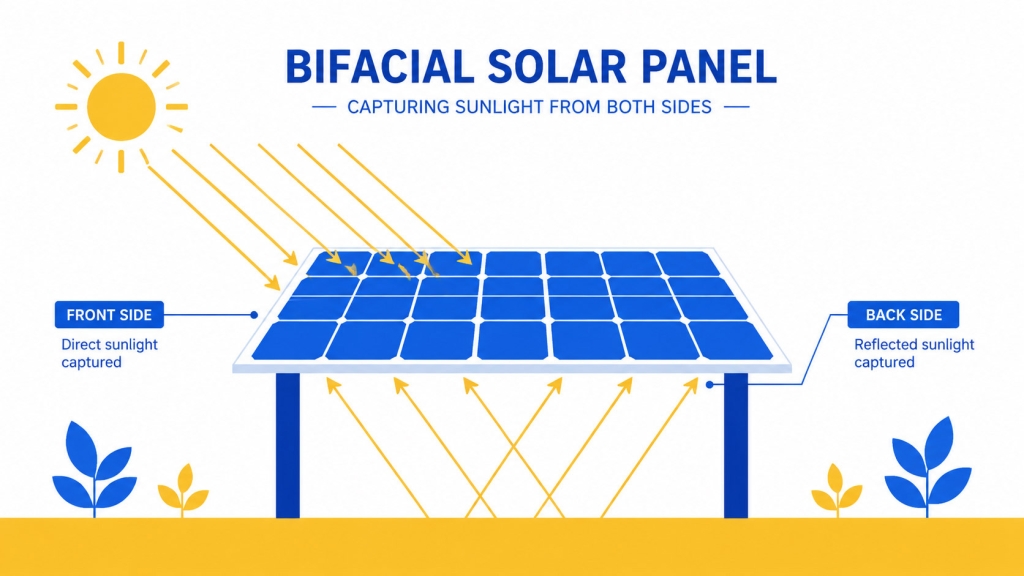
If you bought solar modules a few years ago, "bifacial" meant a premium product reserved for niche applications — experimental tracker setups, snowy terrains, or high-albedo deserts. Fast forward to today, the landscape has completely transformed. According to IRENA's recent report on firm solar economics, bifacial modules now account for a dominant share of global PV shipments.
What was once a specialist choice is now the industry baseline. But if bifacial is the new standard, the question worth asking is no longer "should I go bifacial?" — it is: How do you design your project to maximize the financial benefit?
2. The Economics: Why Bifacial Lowers LCOE
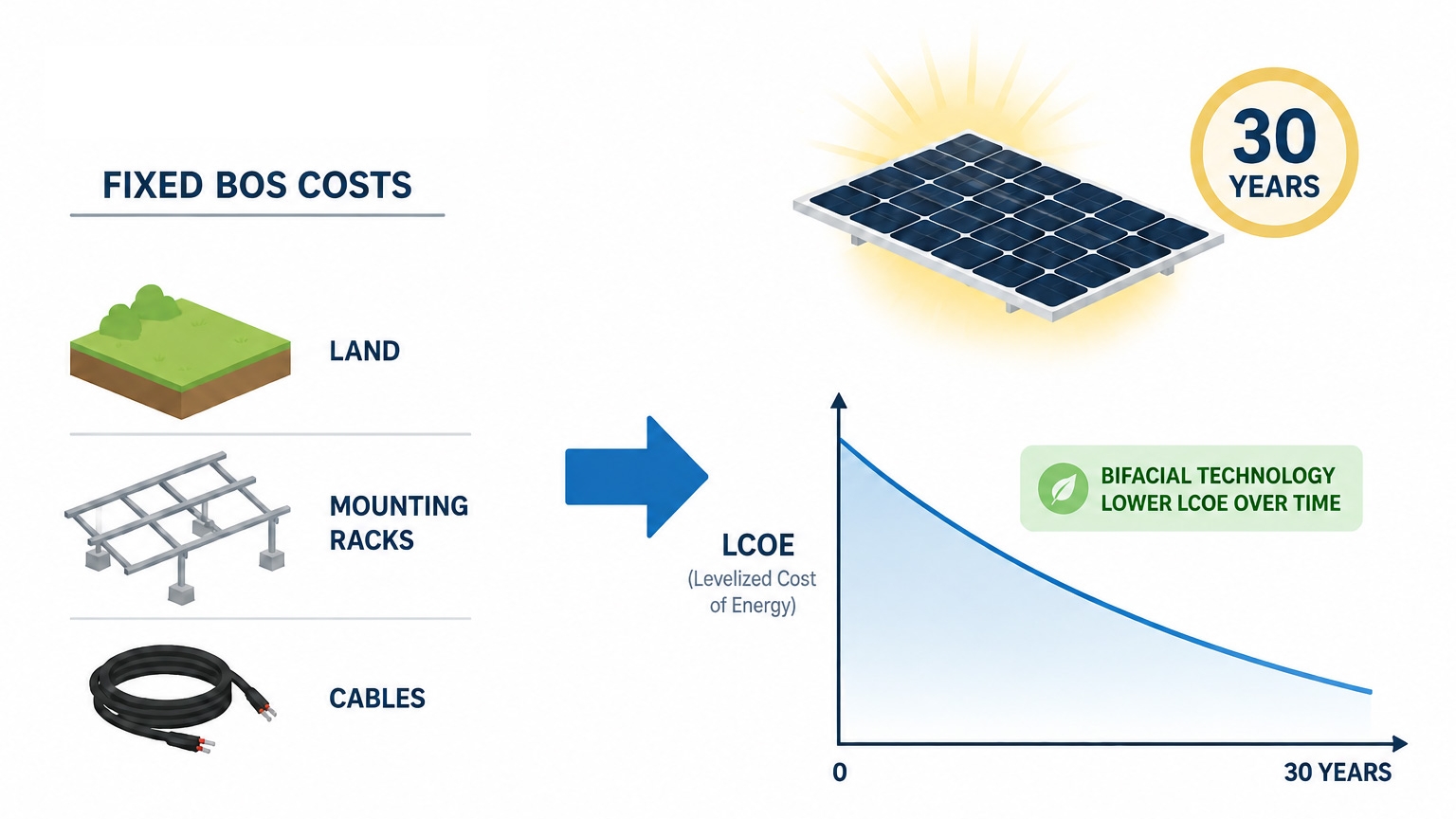
The primary driver behind the bifacial revolution is simple: the price premium over monofacial modules has largely evaporated. When upfront Capex is nearly identical, the economic rationale becomes increasingly compelling.
Rear-side gain has a unique financial property — it adds energy output at near-zero additional balance-of-system (BOS) cost. You are using the same land, racking, cabling, and labor, but producing more kilowatt-hours. Over a 30-year operational lifespan, this continuous rear-side generation effectively dilutes the fixed BOS costs of the entire solar plant, driving down the project's levelized cost of electricity (LCOE) year after year.
However, not all bifacial modules deliver the same level of rear-side performance. Bifaciality factors range from roughly 70% on some back-contact (BC) cell structures to 85% and above on advanced n-type TOPCon designs. That 10–15 percentage point gap is not academic — at utility scale, every bifaciality point compounds into measurable differences in annual energy yield and lifetime project returns. For instance, Astronergy's ASTRO N7 Pro reaches 85±5% bifaciality — due to PF (Poly Finger) for rear-side passivated optimization and finer grid lines for denser current collection networks, and ZBB design.
3. Where Rear-side Gain Hits Hardest
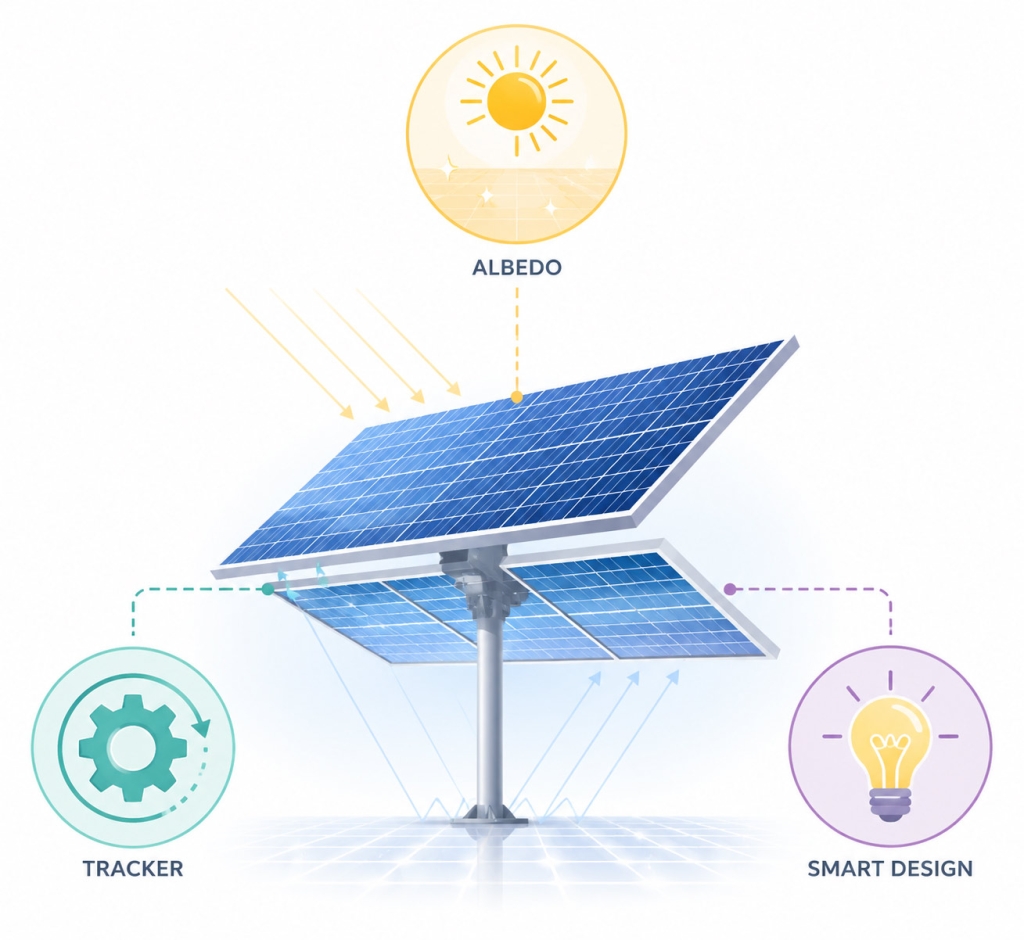
Bifacial gain is not a fixed number on a datasheet — it is a design outcome. Four site and system factors amplify it the most:
3.1 High-albedo Environments
Albedo — the fraction of sunlight reflected by the ground — is the single largest lever for rear-side gain. The lighter the surface, the more irradiance reaches the module's rear. Desert sand, light-colored gravel, snow cover, and white concrete naturally drive albedo higher, channeling maximum reflected light to the back of the module. In desert installations, research shows that rear-side contribution can reach 8–12% of total energy yield — a gain that simply does not exist with monofacial modules on the same terrain.
3.2 Single-axis Trackers
Trackers and bifacial modules are a natural pair. A fixed-tilt system captures rear irradiance only within a limited range of sun angles. A single-axis tracker rotates the module through the day, exposing both front and rear surfaces to optimal light across the full daily arc. This dynamic alignment is particularly valuable in high-albedo environments, where ground-reflected irradiance is abundant throughout the day — the tracker ensures the rear surface stays exposed to that reflected light for more hours, amplifying the rear-side contribution over what a fixed-tilt bifacial array would capture.
3.3 Elevated Ground Mounts
Assuming identical albedo conditions, greater ground clearance enhances rear-side gain by allowing more diffuse and reflected light to reach the module. In practice, typical utility-scale ground-mount installations capture significantly more rear irradiance than low-clearance residential rooftops because they benefit from a dual advantage: elevated clearance and superior surface reflectivity.
3.4 Optimized Tilt Angles
The conventional rule for monofacial arrays — "tilt angle equals latitude" — does not hold for bifacial systems. Because you want to capture ground-reflected irradiance, bifacial modules consistently require steeper tilt. Recent research indicates optimal bifacial tilt angles run 3° to 11° higher than monofacial equivalents. Project designers accustomed to monofacial conventions need to adjust their assumptions — a bifacial array tilted too flat leaves measurable energy on the table.
4. The Bottom Line
You no longer need to ask, "Should I go bifacial?" The real question is: what is your module's bifaciality factor, and is your site designed to capture it?
By pairing high-bifaciality modules like the ASTRO N7 Pro with high-albedo terrain, single-axis trackers, and smart site design, developers can turn rear-side generation from a label into a durable LCOE advantage — one that compounds over a typical long-term project operating period.