

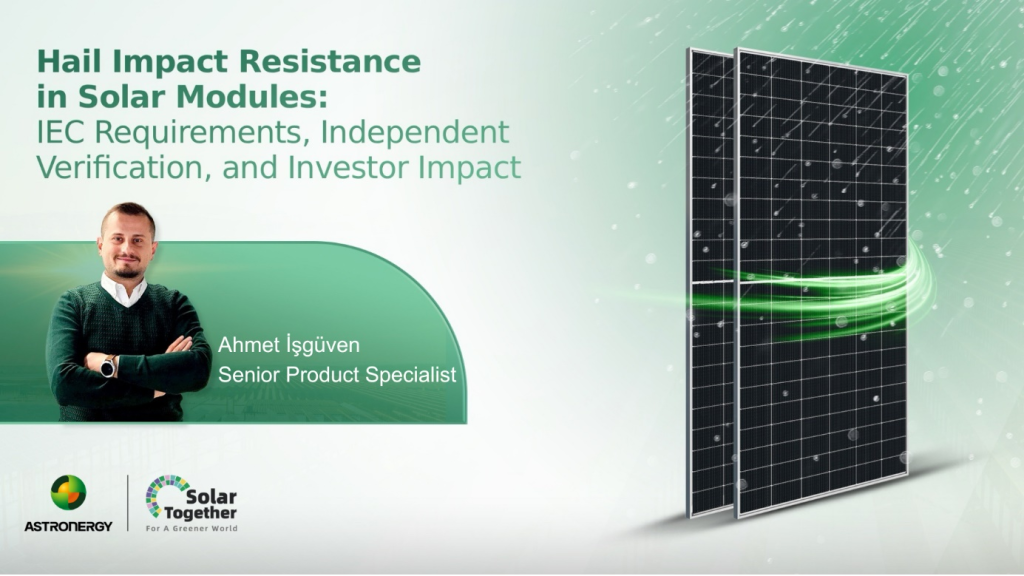
Photovoltaic (PV) modules are required to operate throughout their service life not only under nominal electrical loads, but also under environmental mechanical stresses arising from different directions and varying intensities. Among these stresses, hail impact is considered one of the most critical external factors affecting reliability, as it involves the transfer of high kinetic energy to the module structure within a very short time.
Hail impact creates sudden and localized mechanical stress on the module glass, cells, intercell solder joints, and the glass–encapsulant–cell interfaces. This stress may lead not only to visible damage such as glass breakage, but also to less immediately detectable issues, including microcracks, cell fractures, and weakened electrical connections.
Even if such latent damage does not cause an immediate power loss after a hail event, it can evolve into delayed performance degradation over time when combined with thermal cycling, humidity–heat stress, and field aging. For this reason, hail impact resistance should not be considered as a one-time mechanical test, but rather from the perspective of long-term performance continuity.
The Role of Hail Impact Testing in IEC Standards

One of the primary international references for PV module reliability, IEC 61215, defines various test procedures aimed at verifying long-term mechanical and environmental durability. Within this framework, the hail impact test is intended to confirm the module’s minimum mechanical strength threshold.
Under the IEC approach, the hail impact test is based on propelling ice balls of specified diameter and mass at defined velocities toward the module glass. The primary objective of the test is for the module to complete the test without glass breakage, visible cracking, loss of electrical insulation, or safety risk. After testing, inspections such as visual examination, insulation resistance measurements, and limited power loss checks are performed.
However, by its nature, this test represents a single, controlled stress scenario. In real field conditions, hail impact often occurs in combination with, or following, other aging mechanisms such as thermal cycling, damp heat exposure, and UV radiation. Therefore, while IEC testing provides a necessary baseline, it has inherent limitations in fully representing real-world field behavior on its own.
Kiwa PVEL “Hail Stress Sequence” Test

The Product Qualification Program (PQP) developed by Kiwa PVEL takes IEC tests as a baseline and applies combined stress scenarios to evaluate PV modules under conditions that more closely resemble real field environments. PVEL’s Hail Stress Sequence for Photovoltaic Modules document clearly demonstrates that hail impact should be assessed not as an isolated event, but in interaction with module aging mechanisms.
Fundamentals of the Hail Stress Sequence
The core assumption of the PVEL approach is as follows:
When a PV module is exposed to specific environmental stresses before or after a hail impact, potential damage mechanisms become far more apparent and measurable compared to isolated tests.
Accordingly, the Hail Stress Sequence is structured as follows:
- The module is first subjected to aging stresses such as Thermal Cycling and Damp Heat.
- The hail impact test is then applied.
- After testing, the module undergoes detailed electrical and structural evaluations, including IV curve measurements, power loss analysis, and electroluminescence (EL) imaging.
This sequence reveals whether regions that may weaken over time—such as the glass–encapsulant–cell interfaces or internal cell structures—are triggered or exacerbated by hail impact.
Technical Significance of PVEL Findings
Laboratory and field observations published by PVEL indicate that microcracks formed after hail impact can evolve into measurable power losses in subsequent years when combined with thermal and moisture-related stresses.
This clearly demonstrates that hail impact resistance should not be assessed solely on a “glass broken / not broken” basis, but rather in terms of performance stability and long-term degradation behavior.
Comparison of IEC Hail Impact Testing and Extended Independent Test Programs

The table below provides a technical comparison between the hail impact testing methodology defined in IEC 61215 and the approaches used by advanced independent reliability programs such as Kiwa PVEL PQP and DEKRA.
| Criterion | IEC 61215 – Hail Impact Test | Extended Independent Tests (Kiwa PVEL PQP & DEKRA) |
| Test Philosophy | Single mechanical impact verification | Impact resistance on structures weakened by aging |
| Ice Ball Diameter | 25 mm | 35 mm |
| Impact Velocity | ~23 m/s | ~28 m/s |
| Pre-Test Aging | None | Yes (Thermal Cycling, Damp Heat, etc.) |
| Damage Assessment | Visual inspection + basic electrical checks | Visual inspection, IV curve analysis, power loss evaluation, microcrack and delayed damage analysis |
| Field Representativeness | Minimal | High |
| Bank / Investor Perspective | Minimum adequacy | Indicator of enhanced reliability and bankability |
This comparison shows that while the IEC 61215 hail impact test verifies minimum mechanical integrity, independent programs such as Kiwa PVEL and DEKRA evaluate hail impact in combination with aging-induced weaknesses, offering a far more realistic simulation of field conditions.
In particular, increased impact energy levels and pre-aging steps enable the identification of damage mechanisms—such as microcrack formation, weakened cell interconnections, and delayed power loss—that may not always be captured by IEC testing alone.
Performance of Astronergy Modules in DEKRA, PVEL, and RETC Programs

Astronergy adopts an engineering approach in module design and manufacturing that goes beyond merely meeting IEC requirements, aiming instead for higher mechanical and electrical durability.
As tangible evidence of this approach, Astronergy has been awarded “Top Performer” nine times under the Kiwa PVEL Product Qualification Program, including hail impact-related multi-stress tests. This award is granted not for performance in a single test, but to modules that maintain long-term performance under combined stress sequences.
In addition to PVEL testing, the hail impact resistance of Astronergy modules has also been verified by DEKRA, an internationally accredited independent testing organization. In DEKRA tests, ice balls with a diameter of 35 mm are applied to the module surface at speeds of approximately 28 m/s, representing a stress profile more reflective of real field conditions. These tests provide a detailed evaluation of the post-impact behavior of glass, cells, and lamination integrity, demonstrating that Astronergy modules not only exceed standard thresholds but also maintain structural and electrical stability under high-energy mechanical impacts.
Furthermore, Astronergy has received the “Overall Highest Achiever” title in comprehensive reliability assessments conducted by RETC, a renewable energy testing center affiliated with the German VDE Group. RETC’s methodology extends beyond IEC limits and places field performance at the center of its evaluation framework.
Financial Implications of Hail Resistance from an Investor Perspective

From an investor’s standpoint, hail impact resistance represents far more than the prevention of glass breakage. The critical issue lies in the long-term effects of hail-induced latent damage on energy yield, performance ratio (PR), and cash flow.
Microcracks and weakened interconnections resulting from hail events can widen the gap between P50 and P90 energy yield estimates, increase uncertainty ranges, and consequently raise financing costs. Modules that have proven their performance beyond IEC standards through programs such as DEKRA, PVEL, and RETC reduce this uncertainty and provide investors with a more predictable and secure return profile.
Conclusion: Hail Impact Resistance Is More Than a Test

Hail impact testing is not merely a mechanical check of PV module reliability, but a fundamental pillar of long-term energy yield assurance. Astronergy’s design approach—validated by DEKRA certification, confirmed through nine-time Top Performer recognition by Kiwa PVEL, and supported by the “Overall Highest Achiever” title from RETC—reflects a multi-layered verification strategy.
For investors, this translates into lower performance uncertainty, stronger bankability, and a more secure financial structure over the long term. Astronergy PV modules embody an engineering approach supported by independent testing, aimed at minimizing the long-term field performance impacts of sudden environmental stresses such as hail impact.