

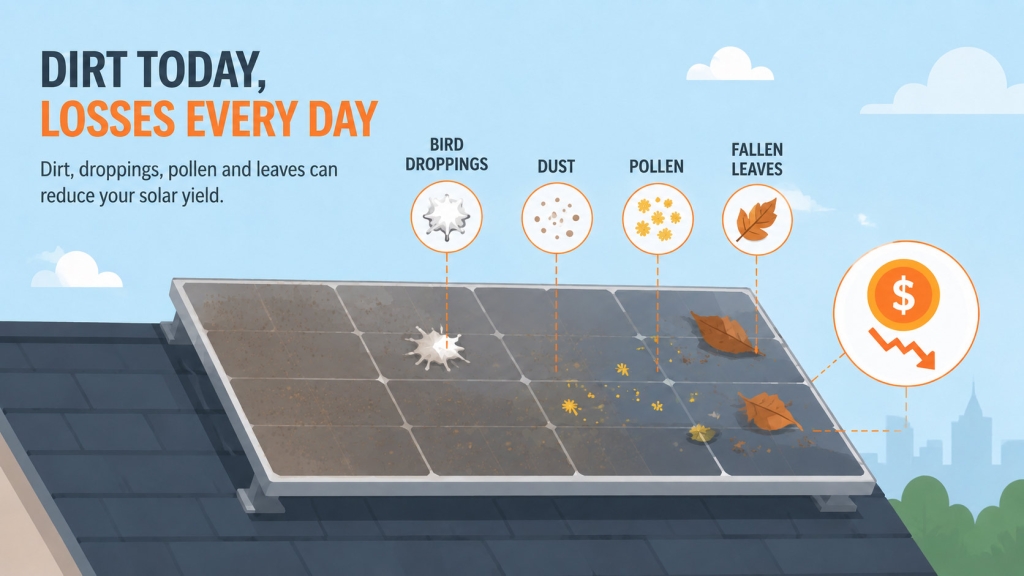
Installing solar panels is a smart investment — but neglecting what lands on them is like leaving money on the roof. Dust, bird droppings, pollen, and fallen leaves form a grimy layer that silently eats into your energy yield.
1. The Invisible Yield Thief
The impact is not trivial: depending on environmental conditions and soiling severity, energy output losses can range from a few percentage points to more significant reductions over time.
Uniform dust is one problem. Localized soiling is a bigger one. A single bird dropping acts as a shade point, creating a hot spot that can drag down an entire string's output. If your monitoring app shows one panel underperforming while its neighbors hold steady — localized soiling is often the culprit.
2. When Rain Does the Job (And When It Doesn't)
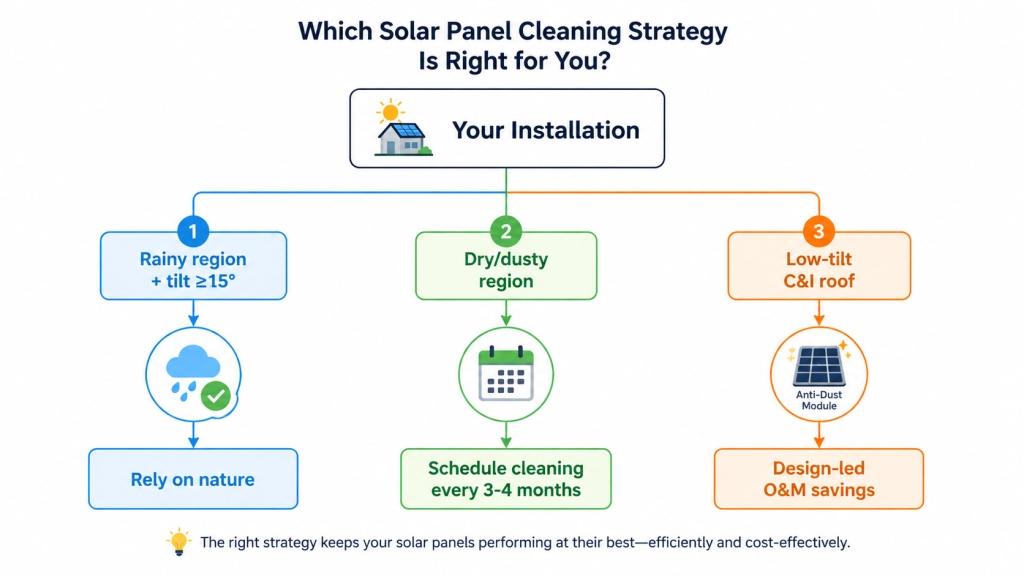
Rain is nature's cleaning service—but it comes with a catch. While a tilt of 10° or more allows water to effortlessly wash away dust, anything flatter slows the flow, leaving dirt behind. This makes natural cleaning a major challenge for low-slope commercial rooftops.
Several scenarios defeat rainwater self-cleaning regardless of geography: prolonged dry seasons, bird-heavy areas (droppings require mechanical removal), industrial zones with oily particulate, and pollen season — where wet pollen forms a stubborn film. Regionally, MENA sandstorms can coat panels in days; Southeast Asian humidity creates persistent residue; and drought-prone areas face water-use restrictions that make passive, design-led solutions especially valuable.
3. DIY Cleaning: A Practical Guide
For residential systems and small commercial arrays, cleaning your own panels is feasible — provided that a few important safety and maintenance practices are followed.
Safety First
- Before performing any cleaning or maintenance work, follow the manufacturer’s safety guidelines and ensure the system is handled in accordance with local electrical safety requirements.
- Clean in the early morning or late afternoon — cold water on hot glass creates rapid temperature differentials, causing thermal stress and micro-crack risk.
- For rooftop work, a safety harness is not optional.
What You'll Need
A soft-bristle brush, deionized water, and a rubber squeegee. In hard-water regions, tap water leaves mineral deposits that permanently reduce light transmission over repeated washes.
What Not to Do
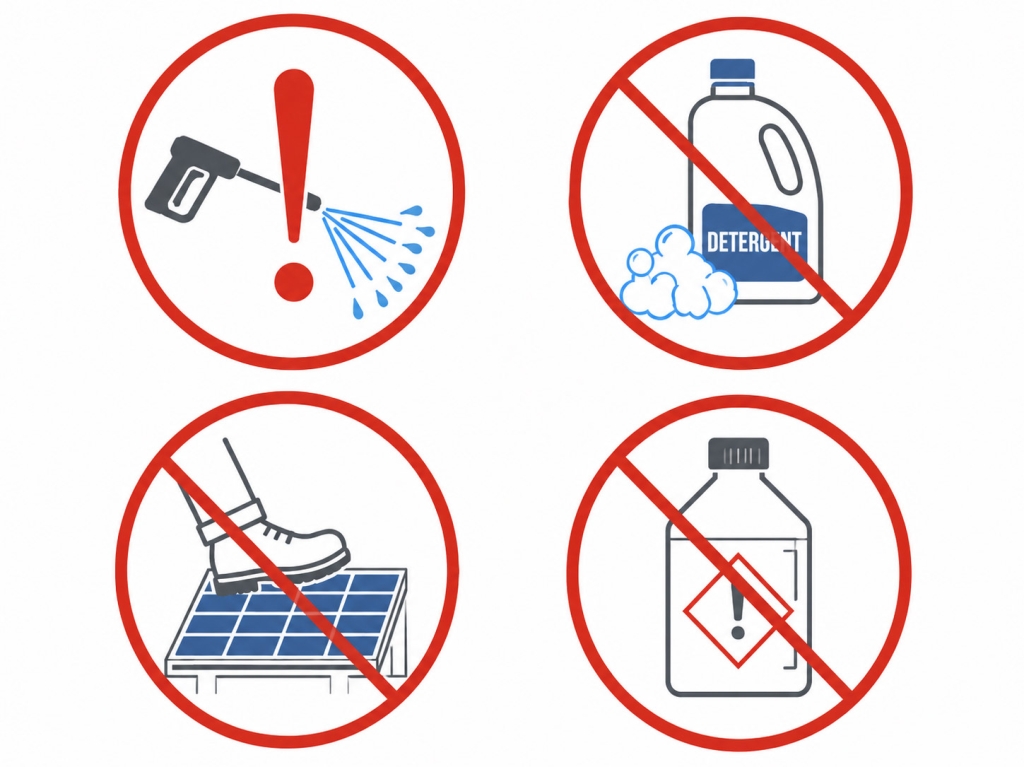
- High-pressure cleaning methods may damage module seals or coatings and could affect warranty coverage if used improperly.
- Never use detergents or abrasive scrubbers — they scratch the anti-reflective coating.
- Never walk or kneel on the panels — micro-cracks grow over time.
- Never use unauthorized chemicals. Even a product that seems harmless can invalidate your 30-year linear warranty. Always check your warranty documentation first.
How Often?
In dry or dusty regions, clean more frequently — dust accumulates faster and rain is less reliable. In temperate climates with regular rainfall, longer intervals between manual cleanings are often sufficient. During rainy seasons, stretch intervals further. The simplest rule: if you can see dirt, you are already behind schedule.
4. Professional O&M v.s. DIY
For larger installations — large commercial rooftops, multi-site portfolios, or utility-scale ground-mount arrays — professional O&M becomes the economically rational choice. It delivers value beyond cleaning alone: thermal imaging detects hot spots before they cause permanent damage, EL inspection catches invisible micro-cracks, and string-level monitoring flags underperformance the moment it begins.
| DIY | Professional O&M | |
| Cost | Near zero | Annual contract; includes preventive inspection |
| Scope | Surface cleaning only | Cleaning + thermal/EL imaging + string monitoring |
| Warranty | Risk of voiding if wrong tools used | Documented records for warranty claims |
| Best Fit | Residential / small C&I | Utility-scale / large C&I |
| Risk | Scratches, seal damage, safety hazards | Insured; catches degradation early |
5. Design-led O&M: How Anti-dust Modules Cut Cleaning at the Source
Low-tilt C&I distributed rooftops often suffer from persistent dust accumulation because limited natural drainage prevents rainwater from washing the modules effectively. To address this challenge, some module manufacturers have introduced frame designs intended to improve rainwater drainage and reduce debris buildup.
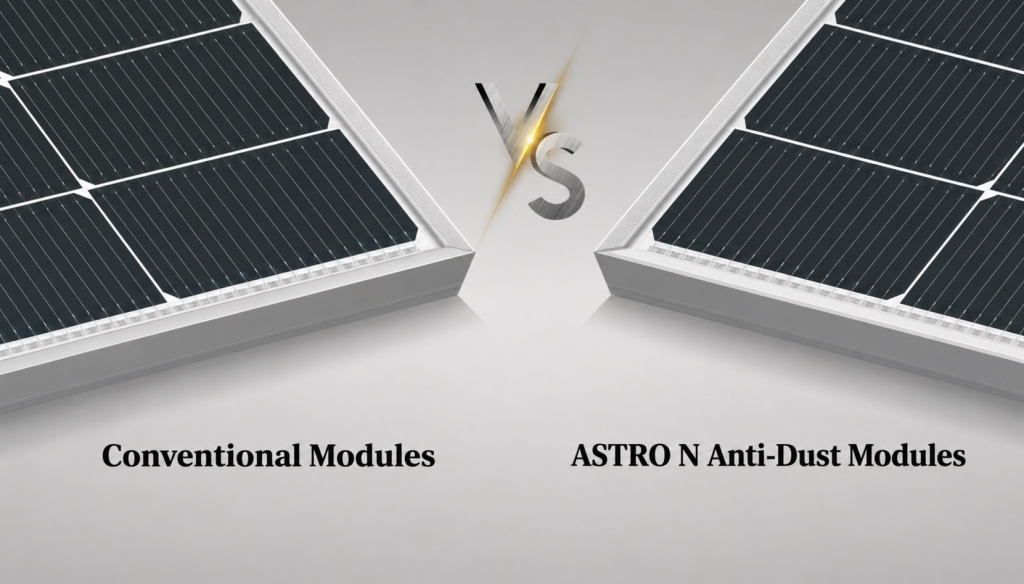
Astronergy’s anti-dust module is one example of this approach. With an optimized A-side design on the short-edge frame, rainwater is channeled off the module surface more effectively, supporting natural cleaning under suitable installation conditions.
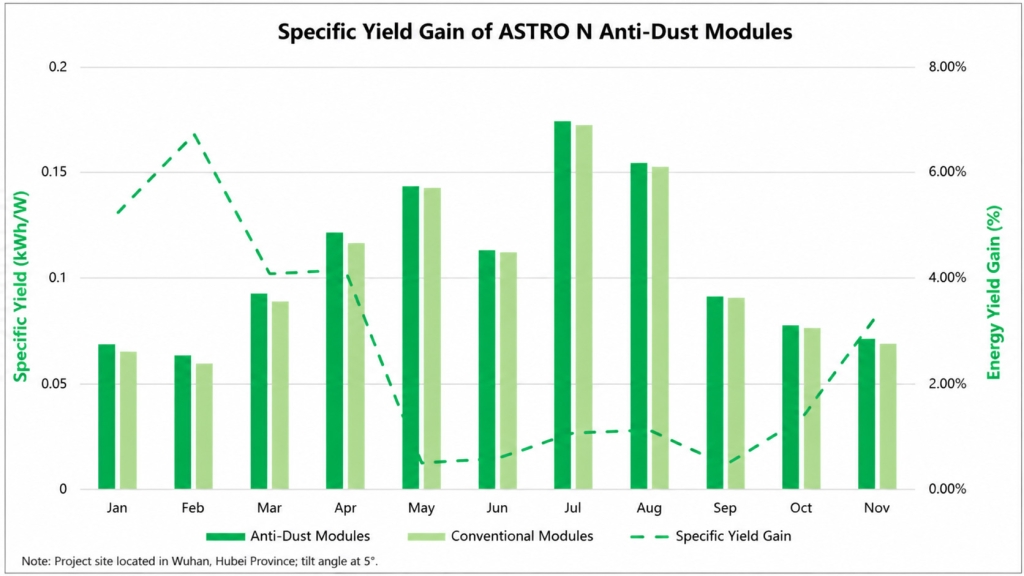
According to field observations from a project in Wuhan, China, systems equipped with anti-dust modules demonstrated measurable improvements in daily energy yield under local operating conditions. Compared with conventional modules, the anti-dust modules deliver an average specific yield of 2.59%, and the highest monthly energy yield gain exceeding 6.65%.
6. The Bottom Line
Solar panel maintenance is not a cost — it is the cheapest yield improvement you can make. Match your strategy to your site: rainy regions can lean on nature, dry regions need scheduled cleaning, and utility-scale installations need professional O&M with documented inspection cycles.
And if you are specifying modules for a new low-tilt commercial project, consider that the right frame design can reduce cleaning frequency from Day 1 — translating to more predictable energy output, simpler O&M planning, and stronger long-term asset performance.
Quick Answers
Q: How often should I clean solar panels?
A: More often in dry or dusty regions, less often in temperate rainy climates. Visible dirt accumulation is often a practical indicator that cleaning may be beneficial.
Q: Can rain clean solar panels?
A: Partially — effective at tilt ≥10° for loose dust. Bird droppings, pollen films, and oily grime require manual cleaning.
Q: Does cleaning void the warranty?
A: Only if improper methods are used — pressure washers, detergents, or unauthorized tools can scratch coatings or damage seals. Always check your manufacturer’s guidelines first.