


As heat waves intensify globally, solar operators are facing a silent threat to energy yield. In hot climates, PV modules routinely operate at 60–80°C cell temperature—far above the 25°C cell temperature defined under Standard Test Conditions (STC). For project owners and technical teams, this isn’t just a weather anomaly; it directly reduces energy yield, accelerates component stress, and quietly erodes project economics.

A 100 MW solar farm in the Middle East can lose hundreds of megawatt-hours annually purely due to high-temperature effects. When module temperatures rise into the 60-80°C range, differences in thermal behavior translate into measurable production gaps.
How can advanced module design counter these high-temperature power losses? By addressing heat through three technical layers: reducing temperature sensitivity at the cell level, minimizing internal heat generation, and ensuring long-term packaging reliability. Understanding these strategies is critical for selecting modules optimized for hot-climate performance.
Why PV Modules Lose Power in Heat
The Temperature Coefficient: A Critical Specification
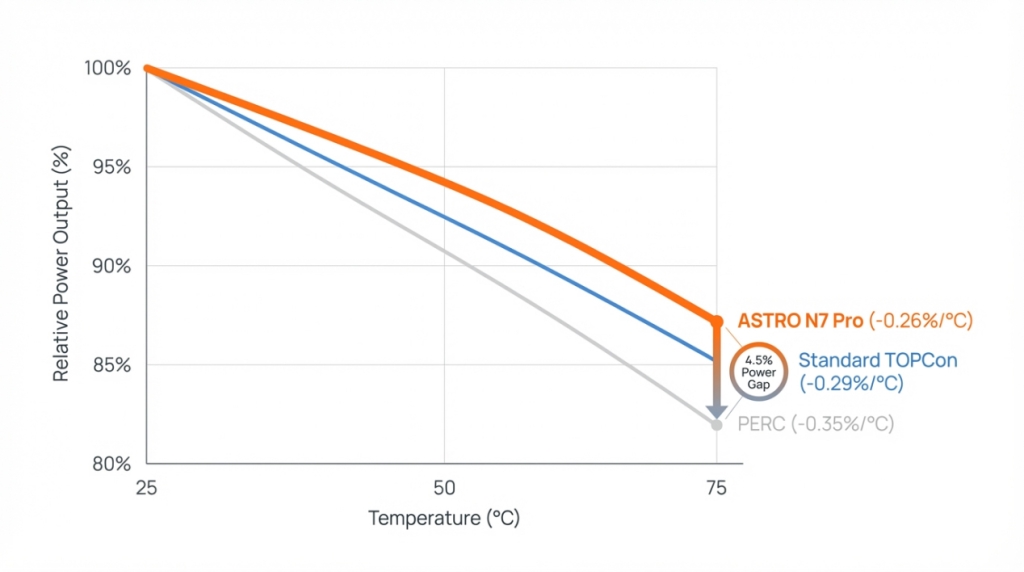
For energy yield in high temperatures, the most important specification is the maximum power temperature coefficient [γ(Pmax)], expressed as %/°C. Because semiconductors change behavior under heat—particularly experiencing a voltage drop—power output naturally decreases as temperatures rise.
To understand the real-world impact, let’s look at the technology evolution:
- Legacy PERC Technology: typically around -0.34 %/°C.
- Standard n-type TOPCon: has established a resilient industry baseline of roughly -0.29 %/°C.
- Flagship n-type TOPCon: cutting-edge models, such as the ASTRO N7 Pro, deliver a highly competitive -0.26 %/°C.
Rule of Thumb: For every 10°C rise above STC (25°C), power output decreases. The mathematical formula is P(T) = P₂₅ × [1 + γ × (T − 25°C)].
Assuming a module operating temperature of around 75°C (50°C above STC), a standard n-type module (-0.29 %/°C) would lose about 14.5% of its rated power, while a flagship ASTRO N7 Pro (-0.26 %/°C) would lose roughly 13%. While a 1.5% difference may sound small, in an industry fighting for every fraction of a cent in LCOE, it can translate into a meaningful operational advantage over the course of a full year of operation.
Two Types of Heat Impact
High temperature affects PV modules in two distinct ways:
- Energy yield impact: Real-time reduction in power output during the hottest hours when solar irradiance is often at its peak.
- Reliability and safety impact: Heat amplifies localized electrical mismatch effects. Under partial shading, dangerous “hot spots” may develop, compounding material stress and accelerating aging.
The Solution Framework
To counter these impacts, modern high-performance modules address heat through a systematic, multi-layer approach:
- Reduce temperature sensitivity (Cell technology layer)
- Lower operating temperature rise (Module design layer)
- Manage long-term thermal stress (Packaging and reliability layer)
Three-Layer Heat Management: From Cell to Package

Layer 1: Cell Technology—Reduce Temperature Sensitivity
The challenge: Since you cannot air-condition a solar farm, the cell itself must be fundamentally less sensitive to heat.
The n-type TOPCon Advantage: Advanced passivation and contact structures reduce recombination losses, contributing to stable electrical behavior across varying temperatures. Simply put, n-type cells maintain better voltage stability under elevated temperatures compared to p-type technologies.
Whether using the industry-standard -0.29 %/°C across the broader ASTRO N series or leveraging the ultra-low -0.26 %/°C capability of the flagship ASTRO N7 Pro for extreme desert environments, n-type platforms provide superior high-temperature power retention.
Layer 2: Module Design—Minimize Heat Generation
The challenge: Resistive losses generate heat internally. The hotter the module runs, the more power it loses—creating a negative feedback loop.
Key approaches in the ASTRO N Series:
- Multi-cut cell architecture: This is like a multi-lane highway system. By cutting a cell into smaller sub-cells (e.g., rectangular formats), the operating current in each section is reduced. Since resistive heating scales with the square of current (I²R), adding more “lanes” significantly lowers internal heat generation.
- High-density interconnection: Zero-busbar (ZBB) architectures provide uniform current collection and lower resistance.
- Optimized bypass protection: Multi-section architectures paired with advanced diode configurations help reduce localized electrical stress under partial shading conditions. This design approach can significantly mitigate hot-spot formation and improve overall system reliability.
Layer 3: Packaging & Reliability—Defend Against Thermal Stress
The challenge: Hot climates don’t just bring heat; they bring high humidity, dust, and massive diurnal temperature swings (e.g., 40°C+ daily variation in deserts).
Key approaches:
- Anti-PID Design: Enhanced passivation resists Potential-Induced Degradation (PID) under the combination of heat, high voltage, and humidity.
- Low-temperature soldering: Reduces initial thermal stress during manufacturing, providing robust resistance against microcrack over 25+ years of thermal expansion and contraction.
- Validation beyond standards: Passing accelerated test sequences like Thermal Cycling (TC 200+) and Damp Heat (DH 1000h+) confirms stable performance over the full project lifetime, not just the early years.
Translating Design into kWh and Economics
The Combined Yield Impact
Energy yield in hot climates is the sum of multiple design choices. In a Middle East utility-scale project with average operating temperatures of 65°C, upgrading to advanced TOPCon architecture delivers:
- Better power retention during high-temperature hours.
- High bifaciality (~80-85%) that partially offsets daytime temperature losses by capturing rear-side albedo.
- Robust low-irradiance performance that extends productive hours in cooler mornings and evenings.
The Cost of Inaction: Economic Translation
For utility-scale solar projects, module selection can directly influence whether a plant meets its expected P50 energy targets or falls short over time. As a simplified illustration, consider a 100 MW solar plant operating at a typical 20% capacity factor. Even a modest ~2% improvement in annual energy yield could translate into approximately 3,500 MWh of additional electricity generation per year.
At typical PPA rates of $0.03–$0.05 per kWh, this would represent roughly $105,000–$175,000 in additional annual electricity sales revenue. Over a 25-year lifespan, this represents roughly $2.6–$4.4 million in additional project value.
The business case is clear: High-temperature optimization isn’t just a technical specification—it is a fundamental driver of project IRR and LCOE reduction. Any initial module premium is typically recovered within the first few years.
Practical Evaluation Checklist for Hot Climates
When evaluating PV modules for high-temperature environments, developers look beyond STC nameplate ratings to several key technical indicators. The following practical checklist can help project teams make a more informed technology comparison.
Temperature Performance
- γ(Pmax): Compare values. Evaluate standard TOPCon baselines (-0.29 %/°C) vs. flagship models (-0.27 %/°C or better) based on your site’s specific maximum temperatures.
- Thermal Modeling: Confirm NOCT/NMOT parameters to ensure accurate yield simulations.
Hot-Spot & Shading Resilience
- Test Evidence: Request specific hot-spot test conditions and dual-diode configuration details.
- Format Evaluation: Factor in the heat-reduction benefits of multi-cut cell architectures and rectangular cell formats.
Reliability Evidence
- Accelerated Testing: Verify TC/DH/PID performance retention under extreme parameters.
- BOM Durability: Ensure encapsulation and backsheet materials are rated for severe daily thermal cycling.
Conclusion: High-Temperature Performance is Engineered, Not Assumed
As heat becomes a more prominent operating condition for PV assets worldwide, high-temperature performance must be evaluated as a system outcome.
Astronergy’s ASTRO N series tackles this challenge head-on. By leveraging n-type TOPCon technology and adopting multi-cut cell design, it reduces internal current and resistive power loss while lowering peak hot-spot temperatures—improving module reliability and system safety. Rigorous packaging validation ensures durability in demanding climates. For the most extreme thermal environments, the flagship ASTRO N7 Pro features a low temperature coefficient of -0.26 %/°C, helping safeguard power output under high operating temperatures.
In hot climates, every percentage point of yield matters. Selecting PV modules engineered for strong high-temperature performance is essential for protecting long-term energy output and overall project value.