


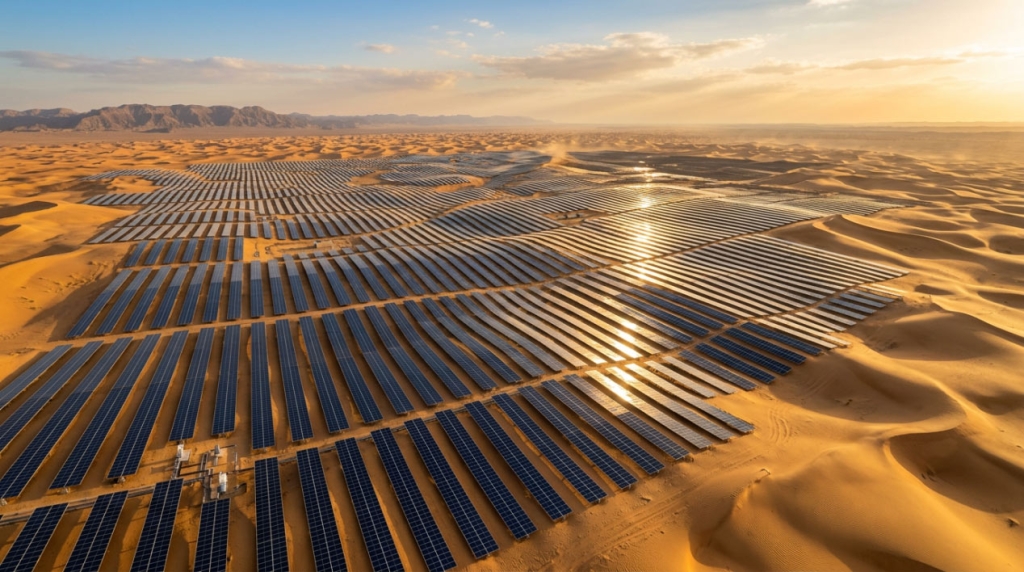
Introduction: The Rise of the Desert Solar Frontier
Roughly one-third of the Earth’s landmass is classified as arid or semi-arid. For centuries, these extreme environments were viewed as barren and inhospitable. Today, however, “marginal lands” are becoming a key pathway to a terawatt-scale clean energy future.
As land competition intensifies and utility-scale solar development accelerates, the industry is increasingly turning to deserts and other arid regions with abundant solar resources. But succeeding in these environments requires more than simply installing modules on sand.
This is where Sand-PV Synergy comes in: a system-level approach that combines gigawatt-scale energy generation with practical measures that support local ecological stabilization and help mitigate desertification drivers such as wind erosion and soil instability. A solar power plant can become not only a power asset, but also a long-term operationally resilient one.
For developers, EPCs, and investors, the key question is bankability: how to convert enormous resource potential into stable, predictable performance under harsh environmental constraints. The answer depends on durable hardware choices and intelligent operations and maintenance (O&M) strategies designed specifically for desert conditions.
The Value Proposition: Unlocking the “Dual Yield”
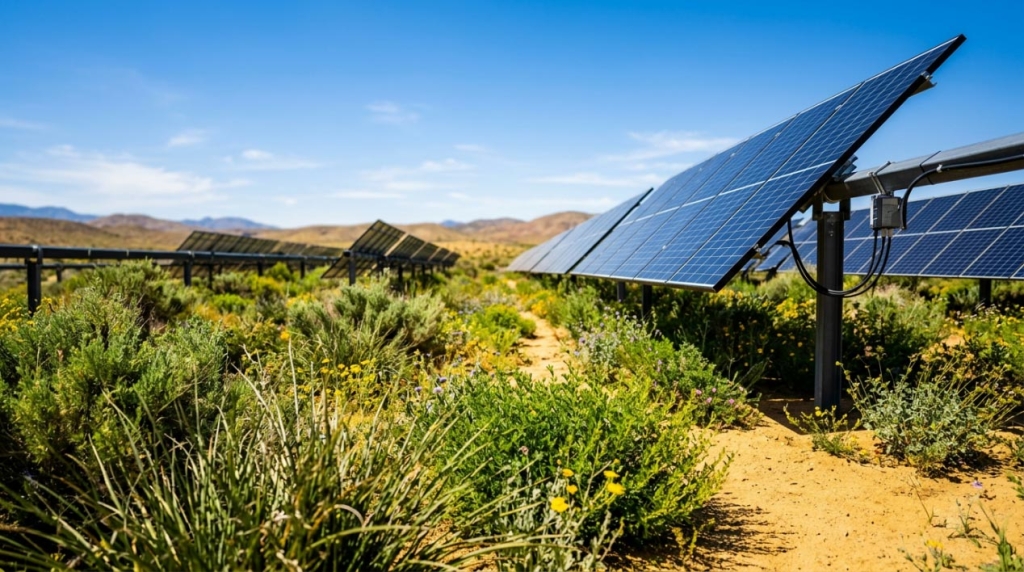
The core investment logic for desert solar is straightforward: vast land availability and high solar irradiation can support low Levelized Cost of Energy (LCOE) and scalable deployment. In many regions, these projects transform historically non-arable land into productive infrastructure with long asset lifetimes.
At the same time, desert projects can unlock a second form of yield-operational and ecological uplift-when the site is engineered to reduce wind speed at ground level, limit soil disturbance, and create a more stable micro-environment under and around the array. This matters because micro-climate stability can translate directly into lower soiling, lower wear, and more predictable OPEX.
A quick note on albedo and bifacial upside
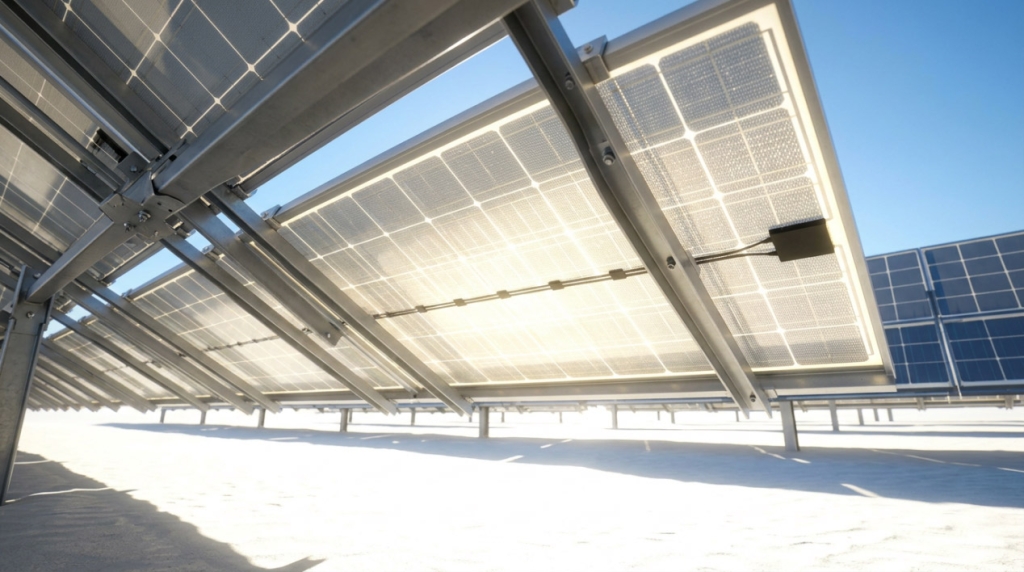
Desert surfaces often exhibit relatively high reflectance (albedo). When combined with high-bifaciality modules, this reflected light can increase rear-side contribution and improve overall energy yield versus lower-albedo sites-especially when array height, row spacing, and ground conditions are optimized.
The “Extreme Environment Tax”: Risks That Erode ROI
Despite strong resource potential, deserts impose a real performance and cost penalty if projects are not engineered for local conditions. This “Extreme Environment Tax” typically appears in three ways:
Soiling and abrasion (the cost of dust)
Wind-blown dust and sand can quickly reduce transmittance and increase mismatch losses. In severe environments, unmanaged soiling can drive significant energy losses over time. Sandstorms also create abrasion risk, potentially accelerating wear on glass surfaces and anti-reflective coatings.
Bottom line: soiling is not just an O&M issue—it is a revenue issue.
Thermal and UV stress (the heat penalty)
Desert ambient temperatures can exceed 50°C in summer, and modules often operate well above ambient, which reduces instantaneous power output. Furthermore, large diurnal swings—hot days followed by cold nights—drive thermal cycling that can accelerate material aging across a 25-30 year design life.
The takeaway: Temperature coefficient, materials selection, and long-term reliability are not just technical specs—they are central to yield predictability.
High OPEX in operational isolation
Remote sites often face constraints such as limited water availability, long logistics chains, and higher labor and transportation costs. In many desert locations, water-intensive cleaning approaches are not sustainable at scale.
Bottom line: OPEX strategy must be engineered from day one, not retrofitted.
Engineering Solutions: Practical Countermeasures for Desert PV
Reducing the Extreme Environment Tax requires moving beyond commodity designs. From bill of materials (BOM) to site layout and O&M, desert PV benefits from purpose-built solutions.
Module design for heat, reliability, and yield
In extreme heat, cell technology and module architecture can materially impact energy yield and long-term performance.
n-type TOPCon modules are increasingly favored for desert applications because they typically offer:
Low temperature coefficient, helping reduce power loss during high-temperature operation;
High bifaciality, supporting stronger rear-side contribution in high-albedo environments;
Robust reliability potential, supporting long service life under thermal cycling and UV exposure.
Astronergy’s ASTRO N series is designed with these requirements in mind. Key design considerations include n-type TOPCon cell technology, high bifacial performance, and structural approaches such as dual-glass options and enhanced encapsulation systems—selected to support durability in harsh climates and to help mitigate risks such as abrasion and high-stress operating conditions. For bankability-focused stakeholders, these characteristics support the broader goal: sustained energy yield and predictable long-term operation.
Mitigating soiling with smarter operations
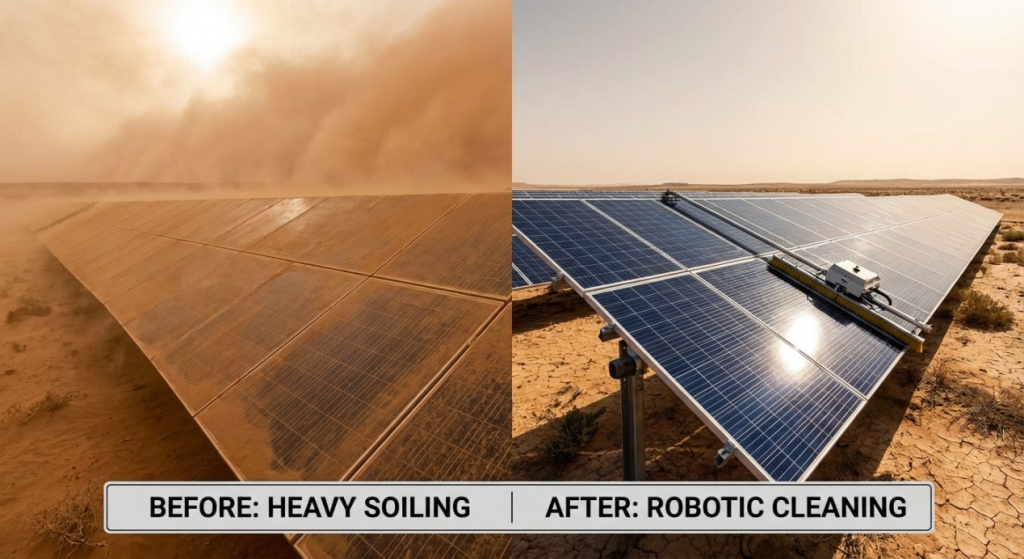
Because water is often scarce in desert regions, many projects are adopting waterless or low-water cleaning strategies, including autonomous robotic systems. When paired with soiling measurement and plant analytics, O&M can shift from fixed schedules to data-driven cleaning, prioritizing cleaning events when expected energy recovery outweighs operational cost.
A practical best-practice approach includes:
Distributed soiling monitoring across representative array zones;
Cleaning optimization based on loss curves and weather forecasts;
Robust QA/QC on cleaning effectiveness to avoid unnecessary cycles.
System-level BOS and EPC considerations (CAPEX + long-term stability)
Desert PV is a mechanical and civil engineering challenge as much as an electrical one. Design choices that improve constructability and long-term alignment can protect both CAPEX and yield.
Typical priorities include:
Foundation approaches suitable for unstable or shifting ground conditions.
Layout and row spacing that balance bifacial gains, shading, and O&M access;
Tracker strategies and storm stow protocols tailored to local wind and sandstorm profiles;
Cable, connector, and enclosure selections aligned with heat and UV exposure.
Closing the Loop: Ecological Synergy as an OPEX Strategy
A pragmatic evolution of desert PV is recognizing that ecological stabilization can be an operationally relevant OPEX strategy—not just a CSR initiative.
Where local regulations, hydrology, and site conditions allow, establishing native, drought-resistant vegetation can yield significant operational benefits. The goal is not to “green” the desert artificially, but to reduce avoidable dust generation and improve site stability. Specific benefits include:
Reduced secondary dust
A major source of soiling is site-generated dust from wind erosion. Root systems bind the soil, lowering the dust load that reaches module surfaces.
Micro-climate benefits
Shading from the array and localized vegetation can influence near-surface temperature and wind behavior. While site-specific results vary, stabilizing the micro-environment can support more consistent operation and reduce stress on equipment.
Lower cleaning frequency and wear
If site dust generation decreases, cleaning intervals can often be optimized—reducing robot runtime, brush wear, and potential long-term surface abrasion.
Conceptual KPI to track: vegetation coverage (%) vs. annual cleaning OPEX ($) over Years 1-5.
Conclusion: A Bankable Path for Desert Solar at Scale
The future of gigawatt-scale solar is increasingly tied to arid and semi-arid regions. By transforming historically marginal lands into productive clean energy bases, the Sand-PV Synergy model is playing a strategic role in supporting national-level large-scale clean energy infrastructure while simultaneously combating desertification and enhancing ecological resilience.
Astronergy’s ASTRO N series modules have been designed with such harsh operating conditions in mind — strong high-temperature performance and high bifacial energy yield potential, validated long-term reliability under extended testing conditions. With successful deployments already powering multiple utility-scale desert and Gobi projects worldwide, Astronergy continues to support developers with bankability-oriented module solutions for harsh environments.