


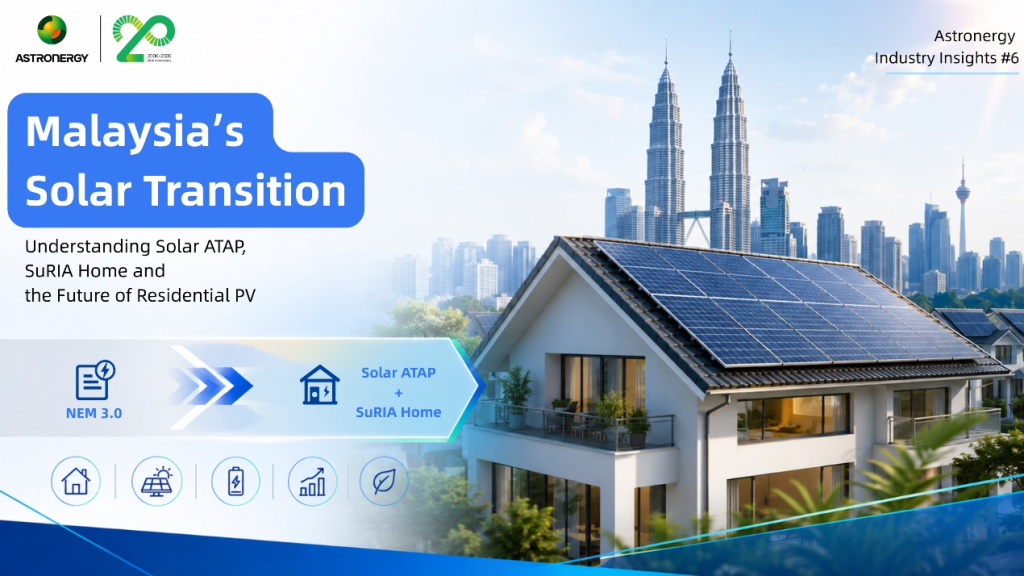
As global demand for sustainable energy continues to grow, Malaysia’s residential solar market is entering a new phase with the transition from NEM 3.0 to Solar ATAP, supported by the newly introduced SuRIA Home incentive program.
Together, these initiatives are reshaping Malaysia’s rooftop solar landscape — lowering entry barriers for homeowners while shifting the focus from maximizing electricity exports to improving self-consumption and long-term energy savings.
Policy Shift: From NEM 3.0 to Solar ATAP
Malaysia’s residential solar market has moved from the previous Net Energy Metering (NEM 3.0) framework to Solar ATAP (Accelerated Transition Action Programme). This transition reflects Malaysia’s broader objective of encouraging greater self-consumption while improving the long-term sustainability of distributed energy integration.
The biggest change is how surplus solar electricity is treated. Under NEM 3.0, homeowners benefited from a stronger net metering mechanism, where excess electricity could be credited against future consumption. Under Solar ATAP, the emphasis shifts toward using solar energy directly when it is generated.
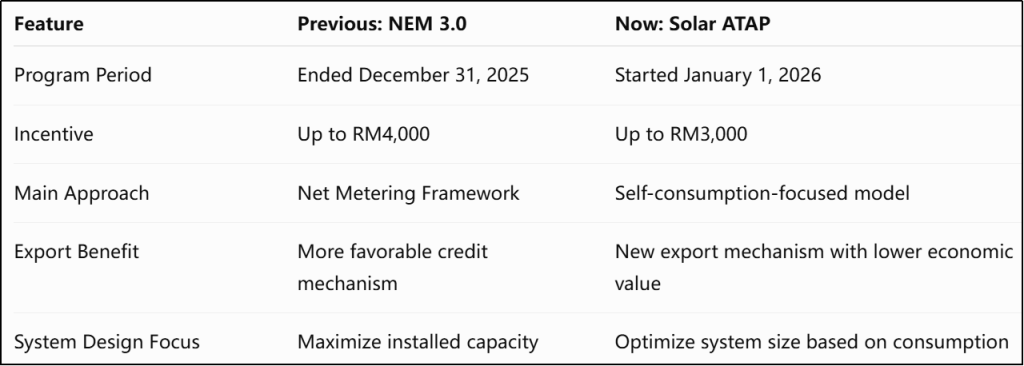
Key Changes Under Solar ATAP
- Self-Consumption Becomes the Priority
Unlike NEM 3.0, where exporting excess electricity provided significant value, Solar ATAP encourages households to consume more of their own solar generation. Under Solar ATAP, every kilowatt-hour consumed directly on-site generally delivers greater economic value than electricity exported to the grid, making self-consumption the primary driver of system returns.
2. System Design Needs to Match Real Consumption
Homeowners should consider their daily electricity usage patterns, especially daytime consumption, when planning a solar system.
3. Greater Opportunity for Smart Energy Management
Energy monitoring, load shifting, and battery storage can help households increase solar utilization and maximize savings.
New Policy Direction: The SuRIA Home Program
The SuRIA Home program is a major government initiative designed to accelerate residential solar adoption in Malaysia. By providing upfront financial incentives, the program helps reduce the initial investment barrier and encourages more households to embrace clean energy.
Key highlights include:
- Cash Rebate: RM600 per kilowatt-alternating current (kWac)
- Maximum Rebate: Up to RM3,000 per system
- Total Allocation: RM150 million
- Expected Beneficiaries: Approximately 45,000–50,000 households
- Application Period: June 1, 2026, to December 31, 2026 (first-come, first-served basis)
- Total Quota: 250 MW
Why This Matters for Homeowners
- Lower Upfront Investment
The rebate reduces upfront costs, making rooftop solar more accessible for Malaysian households. - Smarter System Planning
With excess electricity export becoming less attractive compared with previous policies, homeowners are encouraged to optimize system sizing and align solar generation more closely with their daily electricity usage. - Acceleration of Distributed Energy Adoption
More residential solar installations will support Malaysia’s broader renewable energy transition and energy resilience while strengthening the role of distributed energy resources.
New Strategy: Optimizing Self-Consumption
In the Solar ATAP era, the traditional approach of “installing as many panels as possible” is no longer the most effective strategy.
Rather than maximizing installed capacity, homeowners should prioritize maximizing the amount of solar electricity consumed on-site.
1. Right-Size Your System
Design the solar system according to actual electricity consumption instead of simply maximizing rooftop capacity. A properly sized system can achieve a higher self-consumption ratio and better financial returns.
2. Shift Electricity Usage to Daytime
Use energy-intensive appliances such as washing machines, dishwashers, water heaters, and EV chargers during peak solar generation hours (typically 9 AM–4 PM) to directly utilize solar power.
3. Consider Battery Energy Storage Systems (BESS)
Battery storage allows excess solar energy generated during the day to be used later, increasing self-consumption and reducing dependence on grid electricity during evening hours.
4. Monitor and Optimize Energy Usage
Smart monitoring systems help homeowners understand energy patterns and continuously improve solar utilization.
Astronergy: Supporting Malaysia’s Solar Future
As Solar ATAP shifts Malaysia’s residential solar market toward higher self-consumption, it will drive higher expectations for PV module performance. Solutions that deliver stronger energy yield, long-term reliability, and consistent performance in tropical climates will become increasingly valuable under the Solar ATAP framework.
Astronergy’s n-type TOPCon modules are designed to support these priorities, delivering stable performance under Malaysia’s hot and humid climate conditions.
- Higher Energy Yield for Limited Rooftop Space
Astronergy’s advanced n-type TOPCon technology enables higher module efficiency, helping households maximize solar generation from available rooftop areas. - Reliable Operation in Tropical Environments
With a better temperature coefficient, excellent hot spot resistance and anti-shading performance, Astronergy modules are engineered to maintain stable output under Malaysia’s challenging climate conditions. - Long-Term Value Through Proven Quality
Strict manufacturing controls, rigorous reliability tests, and international certifications help ensure consistent performance throughout the module lifetime.
Malaysia’s residential solar market is entering a new stage, where success will depend not only on wider adoption, but also on smarter system design and long-term performance. As policies continue to encourage greater self-consumption, homeowners, installers, and technology providers will all play an important role in maximizing the value of rooftop solar. With the combined support of SuRIA Home and Solar ATAP, Malaysia’s residential solar market is entering a new stage of growth.