



Italy has updated its renewable-energy requirements for buildings under Legislative Decree No. 5/2026, which implements the EU’s revised Renewable Energy Directive (RED III).
The new provisions apply to applications for building permits and other relevant authorizations submitted from August 3, 2026. They expand and update the existing framework to cover new buildings, major renovations and certain renovations of heating systems.
For the solar industry, the significance is not simply a new requirement to install PV. Rather, the rules broaden the range of building projects where renewable energy needs to be considered as part of the building’s energy design and compliance process.
So, what has actually changed?
1. A broader scope for renewable-energy requirements
Italy already had renewable-energy requirements for new buildings and certain major renovation projects.
The updated framework now applies to:
- New buildings
- Existing buildings undergoing major renovations
- Existing buildings undergoing certain heating-system renovations
The specific requirements depend on the type and scope of the intervention. Not every heating-equipment replacement automatically falls under the same rules; the classification of the intervention matters.
The key change is that certain interventions on existing buildings that previously fell outside the renewable-energy obligation can now be covered by it.
2. Different projects face different renewable-energy thresholds
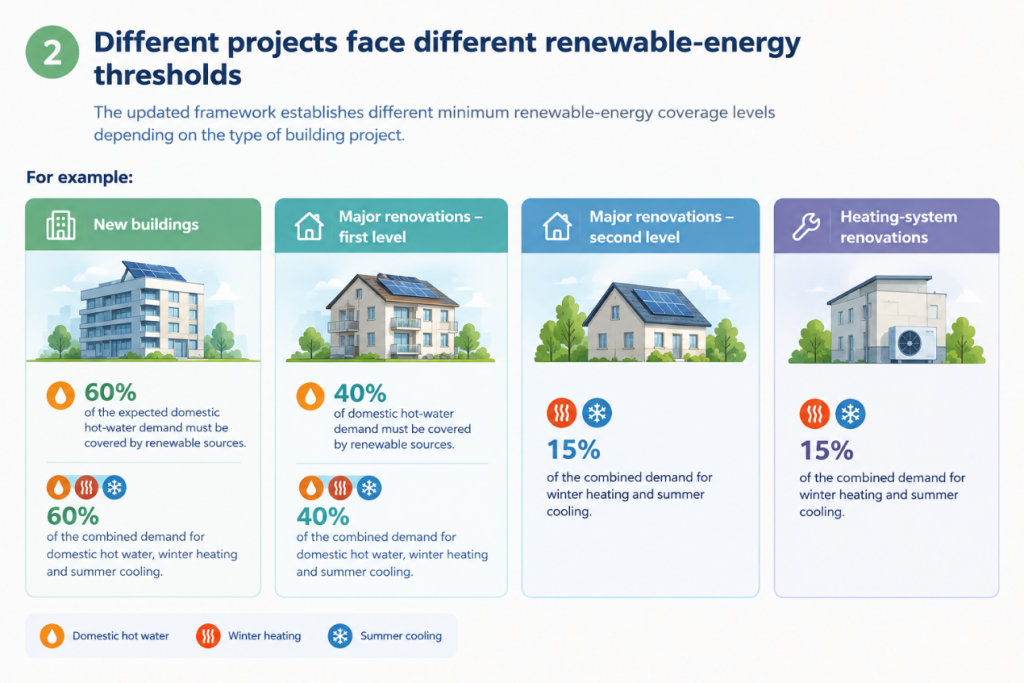
The updated framework establishes different minimum renewable-energy coverage levels depending on the type of building project.
For example:
- New buildings: 60% of the expected domestic hot-water demand must be covered by renewable sources, and 60% of the combined demand for domestic hot water, winter heating and summer cooling.
- Major renovations – first level: 40% for domestic hot water, and 40% for the combined demand for domestic hot water, winter heating and summer cooling.
- Major renovations – second level: 15% of the combined demand for winter heating and summer cooling.
- Heating-system renovations: 15% of the combined demand for winter heating and summer cooling.
For second-level major renovations and heating-system renovations, domestic hot-water demand is not included in the 15% calculation. Public buildings are subject to thresholds that are generally 5 percentage points higher.
These are renewable-energy coverage requirements, rather than a blanket requirement to install PV. Different renewable technologies can contribute, with PV being particularly relevant to the electricity side of the equation.
3. A separate requirement for renewable electricity capacity requirement
The framework also introduces a minimum renewable electricity capacity requirement based on the building’s footprint. The coefficients are:
- 0.05, equivalent to 50 W/m², for new buildings
- 0.025, equivalent to 25 W/m², for relevant existing-building interventions
The calculation is based on the building’s surface area and forms part of the technical assessment of the project. This creates a more direct link between building projects and on-site renewable electricity generation.
For solar, that is particularly relevant because rooftop PV can be one practical way to provide renewable electricity within the building’s available footprint.
The opportunity, however, will depend on factors such as available roof area, solar conditions, building configuration and project economics.
4. Does this mean every renovation now needs solar panels?
Not necessarily. This is an important distinction.
The regulation applies to defined categories of building projects and is subject to technical, economic and functional feasibility.
Where the requirements cannot be fully met, the framework provides provisions for alternative treatment, with the relevant circumstances and calculations documented by the project designer. Protected and historic buildings are also subject to specific provisions where renewable-energy requirements may conflict with applicable conservation rules.
The new rules expand the renewable-energy obligation — they do not make PV mandatory for every renovation project.
5. What could this mean for the PV market?
The most interesting part of the policy may not be the individual percentage requirements, but the broader range of projects in which renewable energy now needs to be considered.
For building owners, renovation can provide an opportunity to consider the building envelope, heating system and electricity supply together rather than as separate investments.
For architects and engineers, renewable-energy requirements need to be considered earlier in the design and compliance process, including the relevant calculations and technical documentation.
For installers and EPCs, the broader scope could create additional opportunities for integrated solutions combining PV with electrification, heat pumps, storage and energy management. As buildings electrify heating and cooling, on-site renewable electricity can become increasingly relevant to the overall energy system.
For module manufacturers, the opportunity is not simply about additional module volume. Existing buildings often come with limited roof area, complex orientations, shading and structural constraints. This can increase the importance of module efficiency, power density and project-specific system design.
6. Why Italy’s changes matter beyond Italy
Italy’s updated framework is part of a broader European policy direction.
While D.Lgs. 5/2026 implements RED III, the revised Energy Performance of Buildings Directive (EPBD) is pushing the building sector in a complementary direction by improving building energy performance and increasing the role of solar energy.
The European Commission notes that the revised EPBD introduces requirements around solar energy in buildings, including the gradual deployment of solar installations on certain new and existing buildings where suitable and feasible.
Taken together, these policies point toward a building sector where energy efficiency, electrification and on-site renewable generation are increasingly considered as part of the same energy system.
For the solar industry, this means the opportunity is not limited to new construction or large utility-scale projects. Building renovation and electrification could become another avenue for integrating PV into the energy system.
What should the solar industry watch?
Italy’s new rules highlight several areas worth watching:
1. Rooftop PV integration
A broader range of renovation projects could create additional opportunities for PV systems designed around existing buildings and their physical constraints.
2. PV + heat pump solutions
As heating systems are renovated and buildings become more electrified, combining renewable electricity generation with heat pumps could become increasingly relevant.
3. PV + storage
Where on-site generation is significant, batteries and energy-management systems could help improve self-consumption, depending on the project’s economics and electricity-use profile.
4. High-performance modules
When available roof area is limited, module efficiency and power density can become important factors in maximising renewable electricity generation within a constrained footprint.
5. Earlier project planning
Renewable-energy integration is increasingly becoming a design consideration from the early stages of a building project, creating a closer connection between architects, engineers, EPCs and renewable-energy suppliers.
The bigger picture
This policy does not create a blanket PV mandate for building renovations.
For the solar industry, that could open an additional avenue for PV deployment beyond traditional new-build and utility-scale projects — particularly where rooftop solar is technically suitable and economically viable.
As building regulations, electrification and renewable generation become increasingly interconnected, the way PV is designed into buildings may become just as important as the amount of PV installed.