


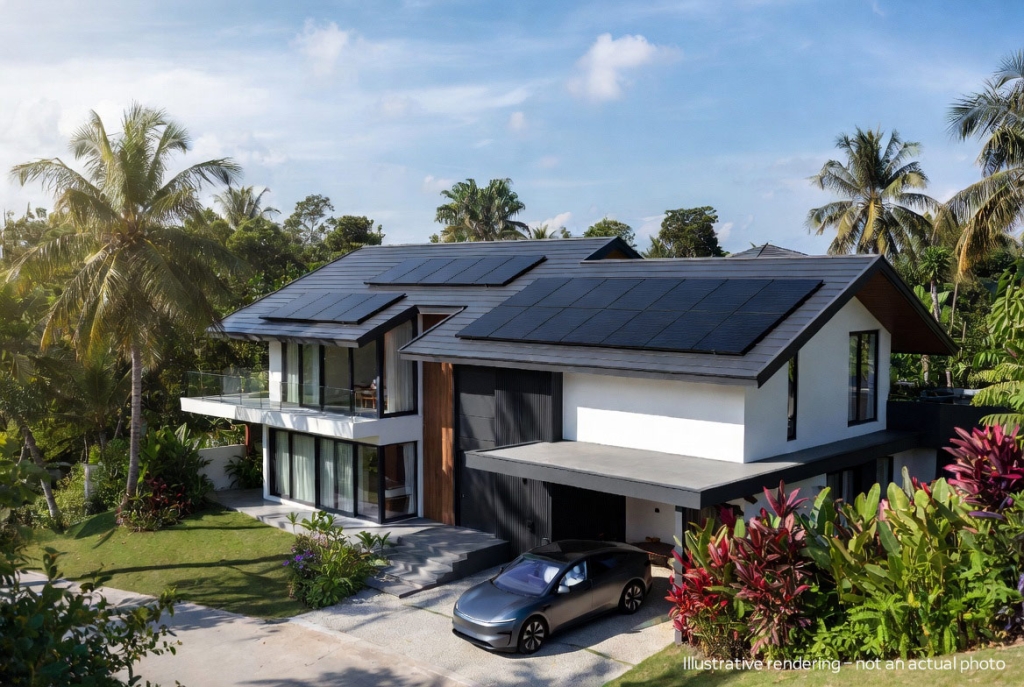
As more households look for practical ways to reduce grid reliance and lower carbon emissions, residential solar is evolving beyond simple rooftop generation. In many homes, electricity use now includes not only air conditioning and appliances, but also connected devices, home energy management, and electric vehicle charging. As a result, homeowners are increasingly looking for integrated systems that can coordinate generation, consumption, and controllable loads more effectively.
https://youtu.be/upOC2ickWqY?si=BdjW9ha6AgVt06XY
A recent residential project in Malaysia reflects this shift. The homeowner, also a content creator, wanted more than a standard solar installation furing the renovation of his house. The goal was to build an integrated home energy system that could offset daytime electricity use, support EV charging, and make better use of on-site solar generation under local net metering rules.
To meet those needs, the project combined rooftop PV, a smart inverter, module-level optimization, and an intelligent EV charger. At the heart of the system is an 11.59 kW solar array built with 19 ASTRO N7 n-type TOPCon bifacial modules. The system is expected to generate around 1,200 kWh of electricity per month.
Why the Home Needed an Integrated Energy Setup
Malaysia benefits from abundant solar resources, but residential demand patterns and weather conditions can make system design more complex. In larger homes, daytime electricity use is often driven by cooling loads, appliances, and smart-home devices. Adding an EV to the household further increases electricity demand, especially if charging is done at home. At the same time, solar output can vary throughout the day because of cloud cover, rain, and uneven irradiation.
For that reason, installed capacity alone was not the only consideration in this project. The homeowner needed a system that could coordinate generation, household consumption, EV charging, and grid export more effectively.
How the System Works
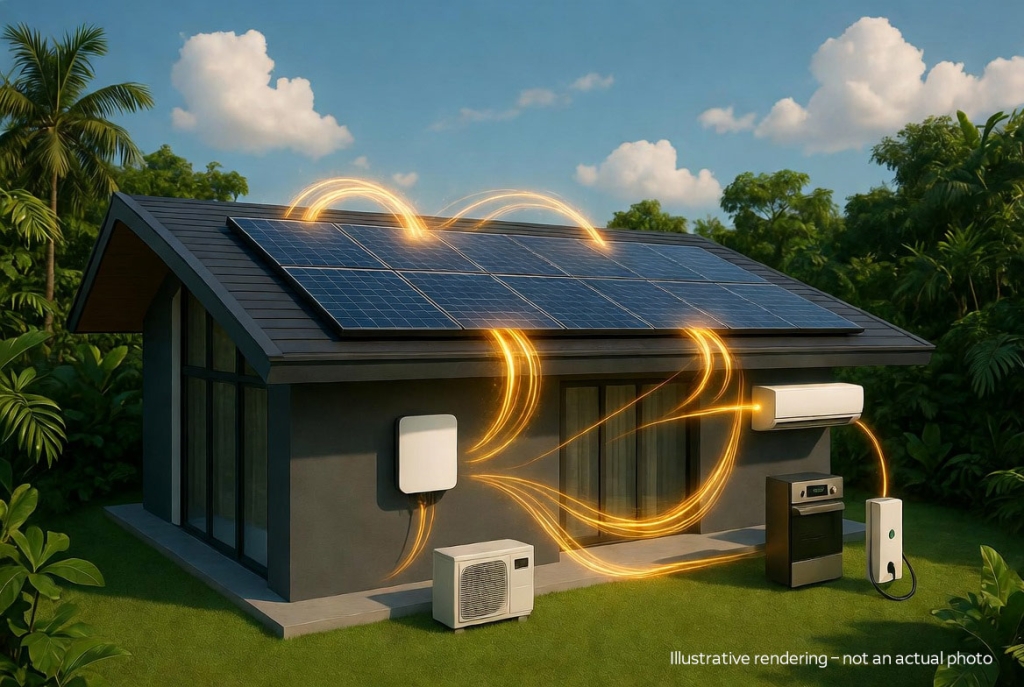
The project was designed around a simple energy flow that links solar generation with household use and EV charging.
Generate
The rooftop system uses 19 ASTRO N7 bifacial n-type TOPCon modules, bringing the total installed capacity to 11.59 kW. With efficiency of up to 23.5%, the modules help maximize output from the available roof area.
Convert and manage
A Huawei smart inverter handles power conversion and coordinates energy flow across the home. Module-level optimizers reduce the impact of partial shading and uneven irradiation—conditions commonly found in tropical rooftop installations. A compatible EV charger is also integrated into the system for seamless home charging.
Supply household loads
Generated electricity is used to support daytime demand in the home, including air conditioning, appliances, and other connected systems.
Support EV charging
When solar output is available, part of the EV’s charging demand can be met with on-site generation, lowering reliance on grid electricity.
Export surplus electricity
When generation exceeds real-time household demand, excess electricity can be exported to the grid in line with Malaysia’s net metering mechanism.
Local Climate: High Heat and Humidity
Malaysia’s hot and humid climate places additional stress on PV modules, which can accelerate performance degradation over time. For this project, module design played a critical role in ensuring stable long-term operation.
Modules with low temperature coefficients and strong resistance to degradation mechanisms such as PID are better suited for these conditions. Astronergy’s ASTRO N series modules, for example, are designed to maintain stable energy output under high temperature and humidity, ensuring reliable performance in Southeast Asian residential projects.
Why ASTRO N7
For residential projects like this, module selection affects more than rated output. It also influences roof-space efficiency, system compatibility, and long-term energy planning.
In this case, ASTRO N7 was selected for several practical reasons:
1. High roof-space efficiency: With an conversion efficiencyup to 23.5% and higher power output, ASTRO N7 enables high installed capacity with fewer panels, which can simplify array design on suitable residential roofs.
2. n-type TOPCon technology: This supports strong performance expectations over the long operating life of a residential system.
3. Bifacial design: This will help capture more reflected sunlight from backside for additional generation.System compatibility: ASTRO N7 works well with mainstream residential inverters and energy management architectures.
4. System compatibility: The modules work well with mainstream residential inverter and energy management architectures.
5. Long-term coverage: A 15-year product warranty and 30-year linear power warranty support long-term residential investment planning, which is relevant for homeowners evaluating lifetime energy yield and long-term system value.
What the System Delivers
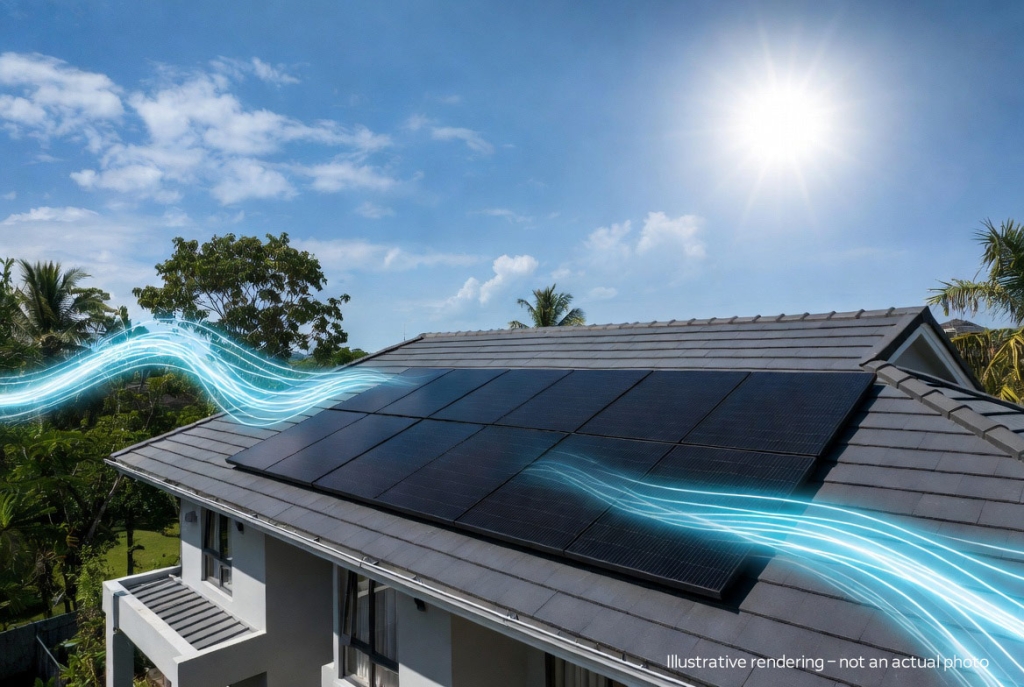
This integrated system delivers value in three key dimensions:
Lowered electricity costs
With an estimated 1,200 kWh/month generation, the system could save the homeowner ~300 MYR/month (depending on local tariffs and usage).
Smarter energy use
The integration of solar generation, EV charging, and intelligent control allows energy to be used more efficiently within the home.
Greater energy flexibility
With net metering support, surplus electricity can be exported, improving overall system utilization and long-term value.
About Astronergy
Astronergy is a Tier 1 manufacturer of high-efficiency PV modules, committed to delivering reliable and high-performance solar solutions for utility-scale and distributed applications worldwide. With advanced n-type technology, Astronergy supports diverse energy scenarios with consistent and bankable module performance.