

The UK government has signaled a clear shift in urgency, moving “further and faster” toward energy security in response to ongoing global energy volatility. With a new package of measures announced by the Energy Secretary, the direction is becoming more concrete: accelerate clean energy deployment, reduce reliance on fossil fuels, and bring solar closer to everyday consumers.
For the solar industry, this is more than policy but a structural opportunity in how solar will be deployed and consumed.
Warm Homes Plan: Distributed Solar at Scale
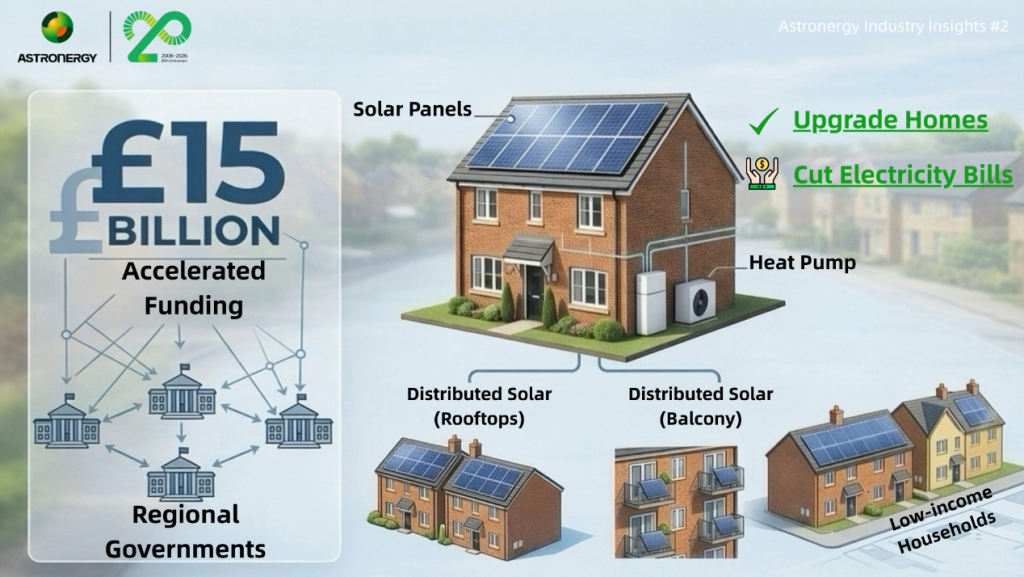
The £15 billion Warm Homes Plan is a central piece of this transition. The funding is strategically allocated to support different segments of the market:
- Around £5 billion is targeted at low-income households (including £600 million in newly committed funding).
- Approximately £2.7 billion is earmarked for heat pump subsidies.
- The remaining budget will be delivered through low-interest loan schemes available to a broader range of households.
What stands out is not just the scale, but how delivery is reshaped. Funding is being accelerated and pushed down to regional levels, enabling a more localized, street-by-street rollout, particularly targeting low-income households.
Solar Goes Mainstream with “Plug-in Solar”
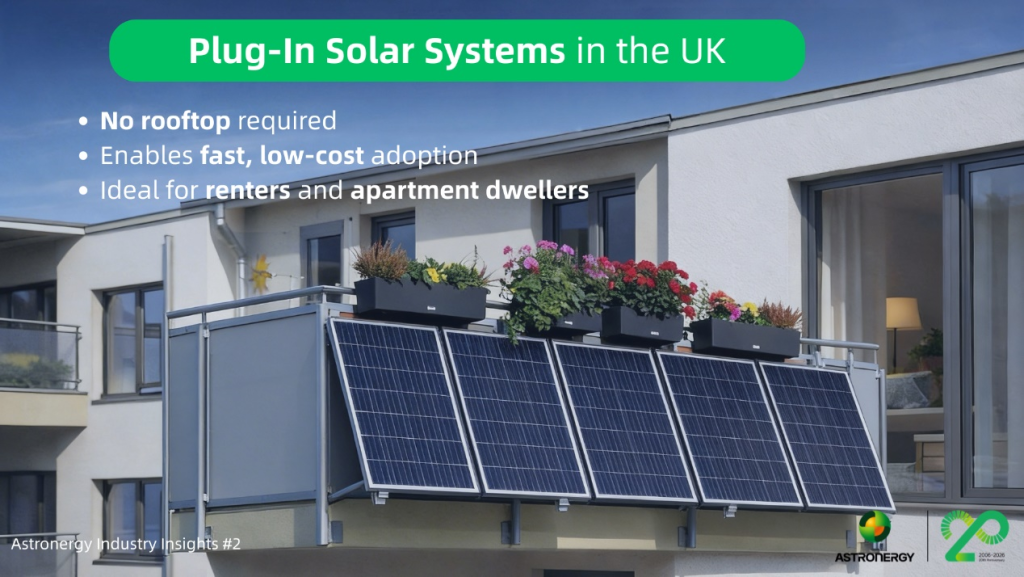
One of the most notable developments is the plug-in solar systems in the UK for the first time. The government has been committed to legalizing it since March 16th, 2026. Already widely adopted in markets like Germany, where hundreds of thousands of units have been installed, plug-in solar represents a new, highly accessible entry point to solar adoption:
- No rooftop required
- Faster, low-cost adoption
- Ideal for renters and apartment dwellers
This trend opens a new distributed solar market in the UK, where simplicity, affordability, and plug-and-play solutions will be key differentiators. Brands that can adapt product design and messaging to this “consumerized solar” segment will gain early-mover advantage.
Faster Deployment: Policy Meets Execution
Alongside these measures, the UK is also working to remove deployment bottlenecks, drawing on lessons from infrastructure acceleration to streamline planning and project delivery.
Speed is becoming a competitive factor in delivery and also in:
- Supply chain responsiveness
- Project support capabilities
- Localized service and technical expertise
At this stage, the market is not only looking for technology, but for partners who can support faster and more localized deployment, especially as projects move closer to residential and community-level applications. Solutions that deliver stable performance under low-irradiance conditions and the UK’s variable weather, while maintaining strong mechanical reliability for rooftop applications, are increasingly relevant.
With ongoing project experience across European markets, Astronergy has been continuously optimizing its ASTRO N series to better match these needs, while also strengthening local collaboration to support more efficient project delivery and installation on the ground.