

The solar industry has moved past the wattage arms race. By 2026, developers, EPC contractors, and lenders are asking a sharper question: Which technology delivers bankable, 30-year yield stability?
The answer no longer lives purely on a datasheet. It is measured in real-world energy yield, degradation curves, temperature resilience, bifacial gain, and lifetime Levelized Cost of Energy (LCOE).
This shift is changing how module technologies are evaluated across global markets. In that context, TOPCon is no longer just one advanced cell technology route among many. It has emerged as the practical mainstream pathway in the n-type era — not only because it offers higher efficiency, but because it provides a proven balance between field performance, manufacturability, and lifecycle value.
Why TOPCon Is Gaining Ground
After a decade driven by scale and cost-cutting, the solar module market has entered a quality-focused reset. According to analysts at CRU, as of the start of 2026, TOPCon accounts for nearly 85% of global solar module production, while conventional mono PERC has declined to less than 5%. This decisive industry-wide shift reflects a clear consensus among manufacturers and project financiers: as margins tighten and procurement standards become more selective, technologies are now judged on a broader set of criteria — long-term reliability, stable energy yield, execution certainty, and bankability.
Compared with conventional PERC, TOPCon offers a clear efficiency step-forward while remaining fully compatible with existing high-throughput manufacturing lines.
More importantly, compared with other advanced n-type pathways such as heterojunction (HJT) or back-contact (BC), TOPCon has demonstrated the most scalable and cost-effective bridge between cell-level innovation and repeatable module-level output. This matters because the efficiency race is no longer about laboratory records; it’s about which technology can translate incremental gains into financeable value across utility-scale, C&I, and residential distributed applications.
This industry transition is also reflected in the strategies of leading module manufacturers. Companies such as Astronergy have expanded their n-type TOPCon capacity in response to growing demand for higher-efficiency, lower-degradation technologies.
Products like the ASTRO N7 Pro are part of this broader shift toward next-generation module platforms designed to meet evolving expectations from developers and investors.
What TOPCon Improves in Practical Terms
TOPCon strengthens several operational parameters that directly impact project economics and asset valuation:
Efficiency Headroom & Upgrade Path
While commercial PERC technology has largely reached its practical physical limits, TOPCon fundamentally shifts the efficiency ceiling for single-junction cell structures. Premium TOPCon modules are already comfortably surpassing the 23% efficiency mark in mass production, outperforming legacy p-type options. More importantly, TOPCon’s technical roadmap provides a clear runway for continuous cell-to-module optimization and next-generation process tuning over the coming years.
Temperature Resilience
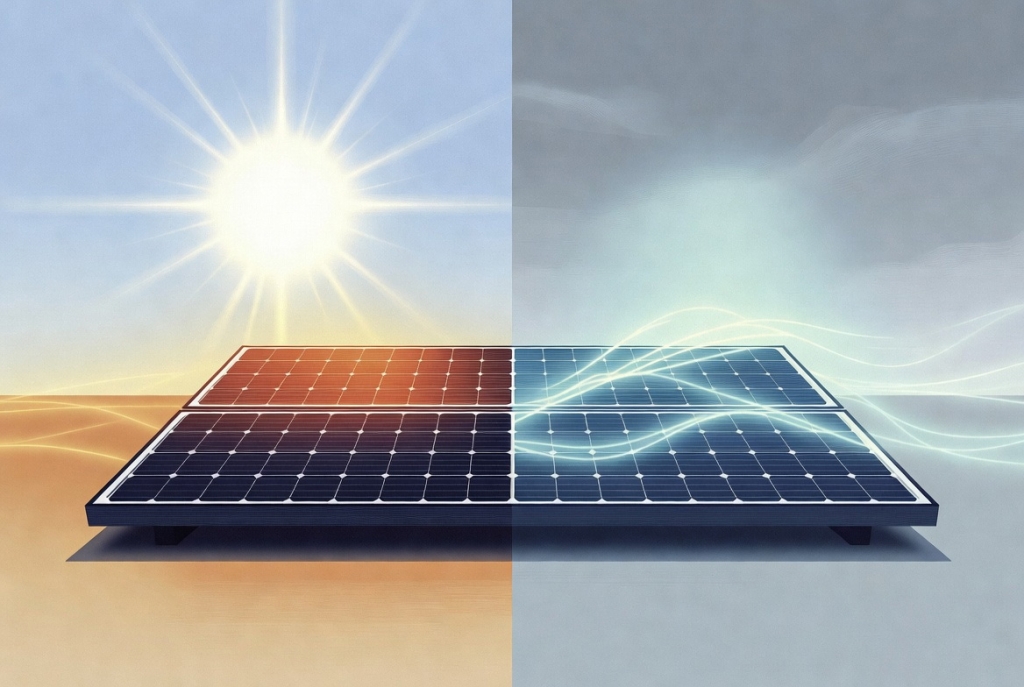
High operating temperatures directly suppress generation in high-temperature environments. With its advanced TOPCon cell structure, the Astronergy N7 Pro delivers an outstanding temperature coefficient of −0.26%/°C, significantly reducing seasonal yield loss compared to previous-generation p-type designs.
Low-irradiance Stability
TOPCon’s carrier lifetime and superior low-irradiance performance improve energy capture under diffuse light, haze, or early/late-day irradiance. For markets with frequent cloud cover, this stability meaningfully raises annual kWh yield beyond front-side nameplate ratings.
Bifacial Contribution
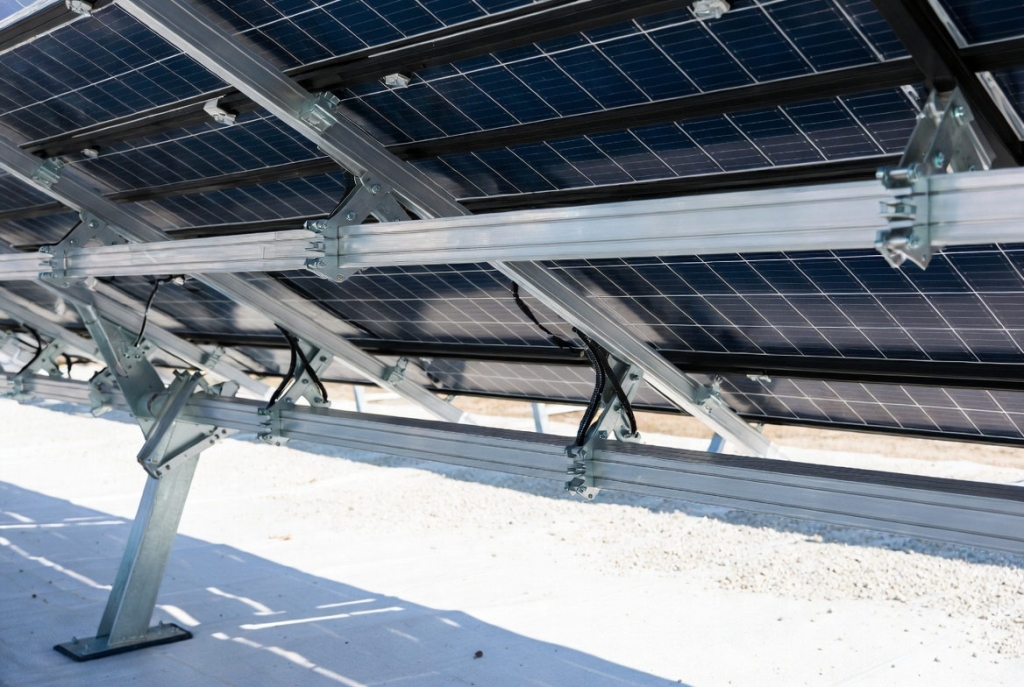
Utility-scale layouts increasingly optimize for rear-side gain. Built on its TOPCon architecture, the Astronergy N7 Pro delivers a bifaciality factor of 85% ±5% in commercial configurations, enabling stronger albedo capture in ground-mount, agrivoltaic, or high-reflectance site designs.
Long-term Degradation Profile
Engineered on commercial TOPCon platforms for ≤1% first-year degradation, the Astronergy N7 Pro delivers ≤0.35% annual linear degradation (Years 2–30), targeting ≥88.85% retained output after three decades. This retention curve directly strengthens project cash flow modeling and secondary market valuation.
Taken together, these characteristics explain why TOPCon has evolved from a cell-efficiency story into a lifecycle value proposition. What makes this evolution commercially significant is that each advantage compounds annually — and that cumulative effect is precisely what the market is now pricing in.
Why the Market Values TOPCon Beyond Headline Power
The value of TOPCon extends beyond nameplate power because different stakeholders prioritize different performance metrics across the project lifecycle:
- 1. Developers optimize for energy yield per hectare.
- 2. Investors model for predictable cash flow and stable output over decades.
- 3. EPCs prioritize execution certainty and reliable commissioning.
- 4. Procurement teams balance efficiency, durability, and supply chain risk.
Why Cell Technology Alone Is Not Enough
Cell structure does not determine final project performance. The real engineering challenge is whether cell-level gains can be converted into stable, field-ready module value.
That depends on interconnection design, high-density encapsulation, thermal management, current collection capability, anti-shading performance, and long-term reliability engineering. The competitive advantage no longer lies only in selecting the right cell platform. It lies in executing the entire technology stack effectively — ensuring that laboratory efficiency survives module lamination, field thermal cycling, and decades of environmental exposure.
A Practical Example of Module-level Translation: The ASTRO N7 Pro
Translating n-type cell advantages into project-ready modules requires deliberate engineering across interconnection, thermal behavior, and shading resilience. To see how this theoretical potential is preserved and amplified at the module scale, we can look at industry-leading platforms like Astronergy’s ASTRO N7 Pro.
Based on rigorous internal testing aligned with IEC standards, the ASTRO N7 Pro demonstrates how superior engineering mitigates field risks:
Combating Heat
A −0.26%/°C temperature coefficient limits summer yield loss. At identical operating temperatures, the N7 Pro minimizes power loss to deliver higher energy yield and generation revenue—a massive differentiator for utility and C&I deployments in high-temperature environments.
Maximizing Bifaciality & Low-irradiance Performance
With bifaciality reaching 85% ±5%, the Astronergy N7 Pro supports stronger rear-side energy contribution, while its optimized spectral response indicates measurable output advantages under diffuse-light conditions.
Shading Resilience & Reliability
The quarter-cut cell design of the Astronergy N7 Pro reduces internal current and hotspot stress, improving partial-shading tolerance. Validated through rigorous accelerated reliability testing, power degradation remains well within specification limits, proving long-term field durability.
LCOE Impact
Engineered for ≤1% first-year and ≤0.35% linear annual degradation, retaining ≥88.85% at 30 years. By mitigating high-temperature yield losses and optimizing Balance of System (BOS) configurations, this performance profile directly translates to a more competitive and predictable Levelized Cost of Energy (LCOE) over the project’s lifetime.
What This Means for Decision-makers in 2026
For developers, investors, EPCs, and procurement teams, the takeaway is clear. TOPCon warrants immediate technical and financial evaluation if your project prioritizes:
- 1. Long-term yield stability over simple short-term CapEx.
- 2. Harsh operating environments involving high temperatures, diffuse-light conditions, or high albedo potential.
- 3. Lifecycle economics (LCOE) evaluated over a 30-year horizon rather than purely nameplate STC wattage.
The relevant question today is no longer, “Which module offers the highest headline power?” The actionable question is, “Which architecture delivers the most predictable, financeable yield per hectare over 30 years?”
Conclusion
The next phase of solar module competition will be won by technologies that convert cell efficiency into predictable yield, lower BOS costs, and financeable degradation curves. TOPCon has already crossed that threshold.
As a BloombergNEF Tier 1 module supplier backed by the global strength of the CHINT Group, Astronergy has been pioneering PV manufacturing since 2006. For us, TOPCon is not merely a short-term product cycle; it is the cornerstone of our mission to create a sustainable and net-zero carbon world. Through the continued evolution of the ASTRO N series, Astronergy combines decades of manufacturing heritage with cutting-edge n-type innovation to deliver practical, bankable value for global projects.