


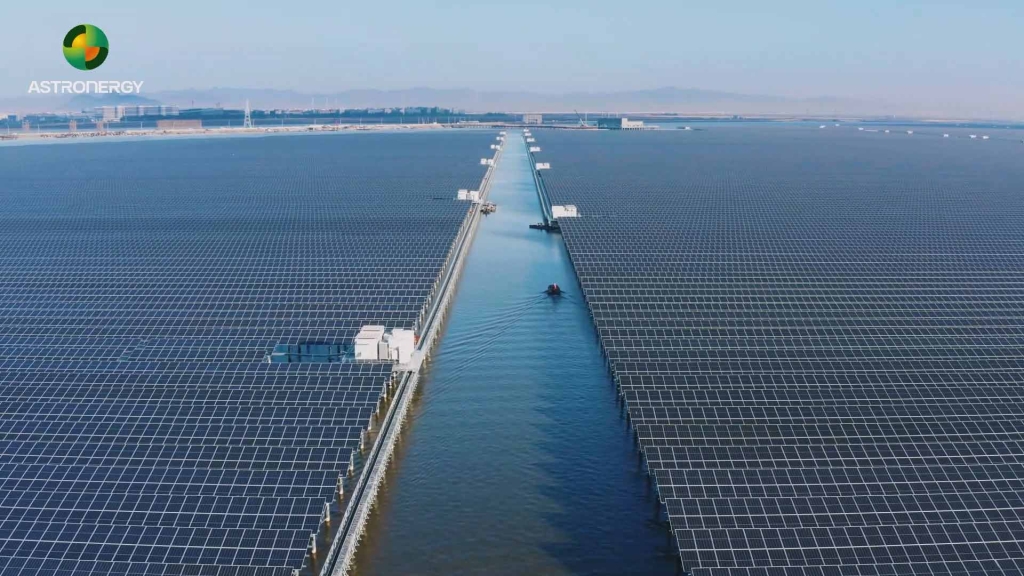
Taihan 550MW Fishing-Solar Hybrid Project, Zhejiang, China — Demonstrating Large-Scale Floating Solar Deployment with Astronergy PV Modules
Floating solar is no longer a niche application. As projects expand from sheltered reservoirs to coastal and offshore environments, the industry’s technical requirements are becoming increasingly sophisticated. Reflecting this evolution, DNV released two dedicated floating PV standards in May 2026 — DNV-ST-C108 and DNV-ST-E309 — providing guidance for the design, operation, and long-term reliability of floating solar projects. The publication of dedicated standards is a sign that floating PV is maturing from an emerging concept into a rapidly scaling segment of the global solar market.
“Floating solar” is industry shorthand for a broader category: water-based PV spanning buoyant pontoons, cable-suspended systems above fishponds, and pile-driven tidal-flat installations. What unites them is not the mounting method but the environment — and the engineering required to survive it.
Water cools panels. Open surfaces eliminate shading. Together, these factors can boost the annual energy yield by 5–10% over equivalent land-based installations. Dual-use models like fishery-solar hybrids unlock revenue without consuming land. But water extracts a price: it corrodes, it moves, and when something goes wrong, you cannot walk over to fix it.
Experience from floating solar projects around the world shows that high laboratory efficiency is only the starting point. Long-term success on water depends on a module’s ability to maintain reliable performance under continuous exposure to humidity, corrosion, wind loading, and other environmental stresses unique to aquatic environments.
Moisture and Salt: How Water Attacks, and How Dual-Coated Glass Fights Back
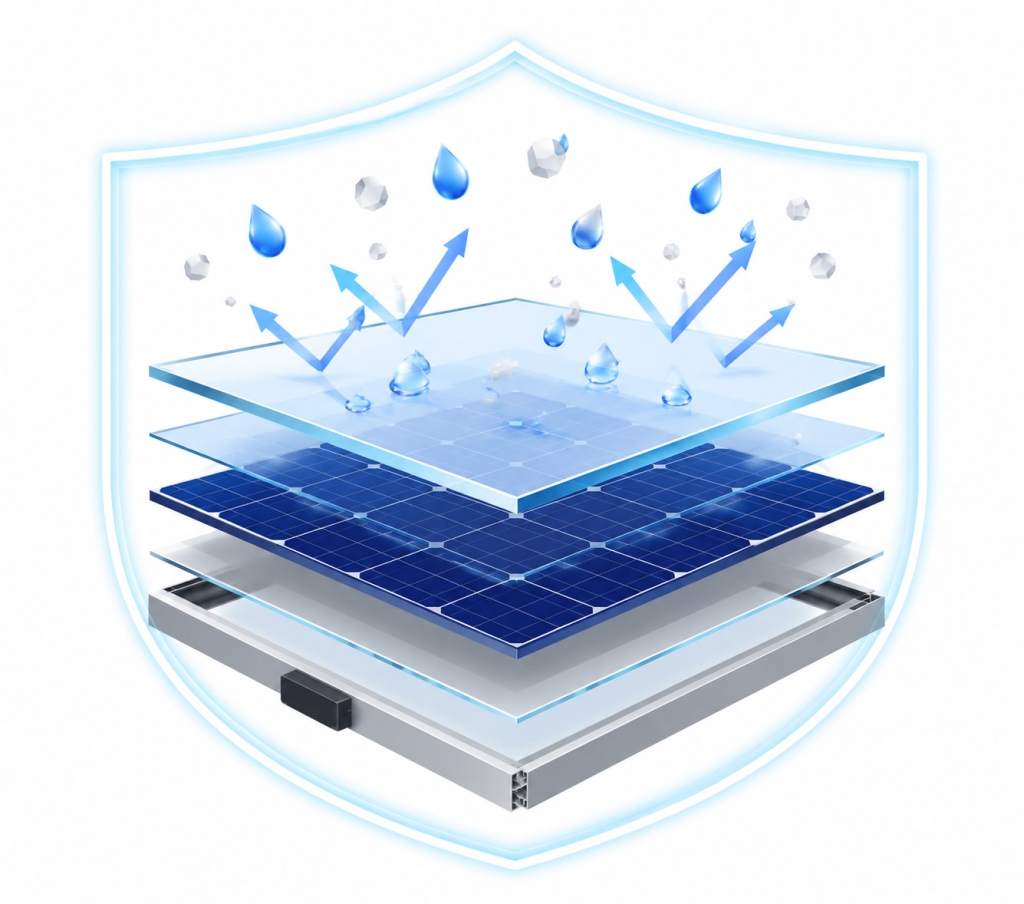
Water vapor seeps through standard encapsulants and backsheets, accelerating degradation and inducing leakage currents year after year. Near the coast, salt spray turns this into an aggressive electrochemical attack — aluminum frames corrode, junction box seals fail, and even the glass surface can be severely etched. “Rated for humidity” and “rated for marine exposure” are not the same thing.
To combat this, dual-glass construction acts as an impermeable barrier against moisture ingress, but Astronergy takes marine defense a step further by introducing dual-coated structural glass. This double-layer coating provides multiple layers of protection for the solar cells, forming a highly dense surface barrier that actively resists salt spray and seawater immersion.
The results are definitive: while single-coated glass often develops visible corrosion spots and suffers a drop in light transmittance in harsh marine environments, Astronergy’s dual-coated glass remains visually pristine. In rigorous salt-spray testing, modules equipped with dual-coated glass demonstrated a power degradation of just 0.47% — roughly 60% lower than their single-coated equivalents. After sweeping through DH3000 (Damp Heat), TC600 (Thermal Cycling), UV, and PID300 (Potential-Induced Degradation) extended testing, the total degradation stays impressively under 3%.
Wind, Waves, and Typhoons: Building a Structure That Moves with Water
A land-based array contends with gravity. A floating array contends with continuous dynamic loading — wave action that never stops, and the possibility of super typhoons. Over 30 years, micro-vibrations propagate into cells and connectors. Fatigue failures do not announce themselves.
For near-shore and tidal-flat installations, cable-supported flexible mounting systems offer an alternative that avoids wave impact entirely: long-span tension structures elevated above the water. These structures contend primarily with wind and tidal loads rather than direct wave action.
At the module level, durability remains equally important. Corrosion-resistant aluminum frames, combined with high-strength mounting hardware, help modules withstand long-term exposure to wind, salt spray, and dynamic loading. These designs are typically validated through wind-tunnel testing, dynamic load cycling, and corrosion-resistance assessments such as CASS (Copper-accelerated Acetic Acid Salt Spray) testing. At the system level, standards like DNV-ST-E309 now codify mooring design — the industry has moved from “hope it holds” to “prove it will”.
Maintenance Where You Cannot Walk: Why Prevention Beats Repair
On land, bird droppings and dust define a cleaning schedule. On water, algae and salt residue create hot spots — and you cannot walk across the array to wash them. A failed junction box seal is not a maintenance ticket; it is an electrical hazard. Every repair requires a boat and calm weather. Investment in preventive engineering pays back disproportionately over decades.
Prevention starts at the module level: IP68-rated junction boxes seal out moisture, self-cleaning glass coatings reduce residue adhesion, and optimized tilt angles balance generation with natural rain washing. When prevention reaches its limit, the fallback is validated survival — and manufacturers have developed proprietary testing to prove it.
One such protocol, PIT (Pressure Immersion and Temperature), runs 500 cycles of seawater immersion under repeated temperature and pressure extremes — simulating years of marine exposure without human intervention. Subjected to this rigorous sequence, Astronergy’s modules demonstrated a degradation of just 0.33%. To further validate their resilience, the modules successfully withstood 35mm hail impacts at 26m/s and 2,000 cycles of dynamic mechanical loading (±1500Pa), ultimately earning PIT certification from the independent safety science leader, UL Solutions. In floating solar projects, reducing the need for maintenance can be just as important as maximizing energy yield. Reliability is often the factor that determines long-term project value.
Proven on Water
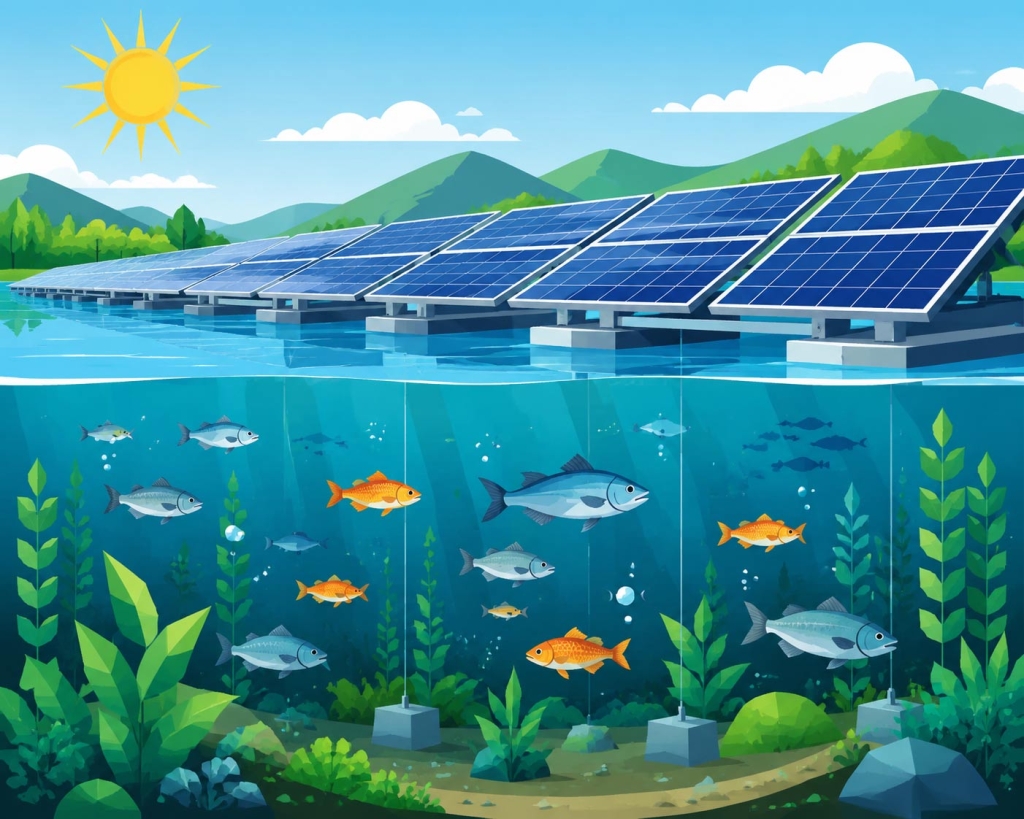
At Xinghua Bay in Fujian, 75 MW of ASTRO N series modules — supplied as part of a 100 MW total installation — face the full marine environment: salt spray, waves, UV. At Taihan in Wenzhou, one of Asia’s largest fishery-solar hybrids deploys 1.396 million modules, generating approximately 650 GWh annually — hailed by China Central Television (CCTV) as Asia’s largest fishery-solar hybrid plant. Wenling in Zhejiang took a different approach: 185,000 dual-glass modules were deployed alongside tidal turbines, marking China’s first installation to prove solar and tidal generation can coexist.
These projects represent a growing portfolio spanning inland fishponds to tidal flats — backed by Astronergy’s BloombergNEF Tier 1 status, its recognition as a Kiwa PVEL TOP Performer (10-time recipient, awarded in 2014, 2017–2018, and 2020–2026), and its participation in drafting China’s offshore PV standard. For procurement teams evaluating water-based projects, dual-glass construction, the right encapsulant, typhoon-rated mounting, and third-party PIT certification are now essential — not optional.
The Water Is No Longer a Barrier
Floating solar is no longer an experiment. The standards exist. The testing protocols exist. The project evidence exists. For developers evaluating a site covered by water, the question has shifted from “can modules survive out there?” to “which modules have already proven they can?”
Astronergy’s ASTRO N series — with dual-glass construction, marine-validated frame options, and third-party PIT certification — is among the module platforms that have answered that question across fishery-solar hybrids, tidal-flat installations, and offshore deployments. For EPCs and developers planning water-based PV, that track record is where due diligence begins.