


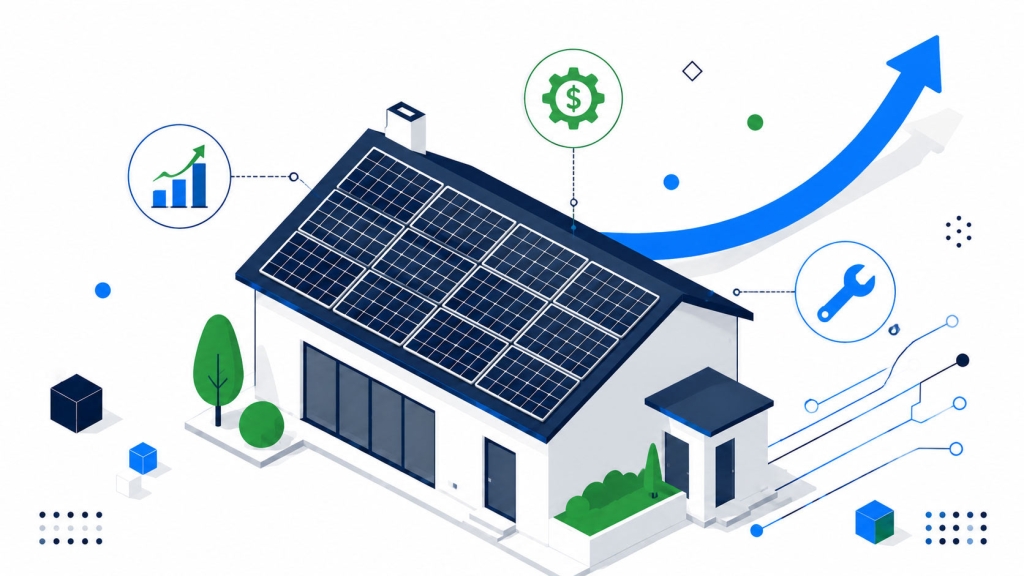
Higher Wattage Is About System Economics, Not Numbers
The next phase of solar module innovation is not simply a race for higher wattage — it is a race to deliver greater system value. Across the industry, module power ratings continue to rise, from 600 W-class modules to 700 W-plus platforms, reshaping project economics. But the real measure of progress is not simply how many watts a module delivers — it is how efficiently that power translates into lower total project costs and smoother installation. One of the key indicators of this evolution is power density: how much generating capacity a module delivers within a practical size and weight.
The economic logic is straightforward. Every watt of module power added to a project reduces the number of modules, mounting rails, clamps, cables, and labor hours needed to reach the target system capacity. This is the BOS (Balance of System) cost story — and it is one of the primary drivers behind the industry’s adoption of higher-power modules.
But higher power also requires thoughtful design. As module formats continue to evolve, manufacturers must balance output gains with practical considerations such as handling, transportation, and installation practicality. The real design challenge is delivering more power while ensuring modules remain optimized for real-world project conditions.

How Higher Module Power Lowers Your Total Cost
Think of a solar installation as a counting exercise. A 10 kW system built with 400 W panels needs 25 modules. With 475 W panels, you need just 21 to reach nearly 10 kW — four fewer. While actual module counts depend on inverter sizing, roof layout, and string design, the reduction in component quantity illustrates the BOS advantage of higher-power modules. Fewer modules mean fewer mounting rails, fewer clamps, fewer cables, and fewer hours of labor. The cost of the panels themselves is only part of the equation — the rest is everything that connects and supports them.
The impact becomes more significant as project scale increases, where reductions in module count can translate into savings across mounting, cabling, logistics and installation. Higher module power compresses the entire bill of materials — and that compression is why procurement decisions are increasingly reflecting a focus on total system economics.
When More Wattage Creates New Installation Challenges
If output were the only consideration, module formats could continue increasing in size. However, real-world installations require a balance between power, format, and handling efficiency. But solar panels are not spec sheets — they are physical objects that need to be carried up ladders, positioned on roofs, and secured against wind in all four seasons. A module that requires additional handling resources can increase labor requirements across every installation. On a steep, tiled residential roof, larger formats can introduce new considerations in handling, transportation, and installation.
Higher power modules can improve project economics, but power output alone does not determine real-world value. As module formats continue to grow, factors such as structural loads, transportation requirements, and installation efficiency become increasingly important. A module that appears cost-effective on a datasheet may not always deliver the lowest total project cost once system-level considerations are included.
This is the design tension at the heart of the industry: push power higher while maintaining practical installation efficiency. The companies that solve both sides of this equation earn the confidence of installers and project stakeholders — because a module’s value is ultimately measured not only by its specifications, but by how effectively it performs in real-world conditions.
Why Power Density Is the New Competitive Metric
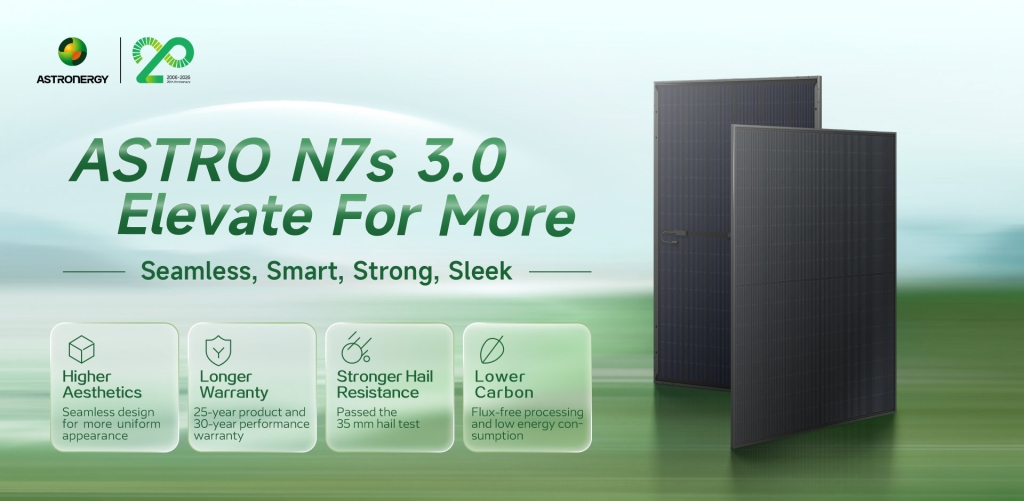
The key to this balance lies in optimizing module design to achieve higher power density while maintaining practical installation requirements. Achieving higher power density requires refining every layer of module design — from cell technology and interconnection architecture to layout efficiency.
This design philosophy is reflected in Astronergy’s ASTRO N7s 3.0 series, which demonstrates how optimized module formats can deliver higher output while integrating smoothly into established installation workflows. The series delivers up to 480 W in 48-cell formats and up to 535 W in 54-cell formats — weighing approximately 24.5 kg for the 48-cell variant and 26.9 kg for the 54-cell variant. Both configurations remain within a familiar weight range for residential installation workflows and are backed by a 25-year product warranty, helping installation teams adopt higher-power solutions without disrupting established workflows.
It is a design philosophy that prioritizes power density over power alone. The value becomes clear when high-output modules can deliver stronger system economics while fitting naturally into real-world installation workflows — benefiting installers, EPC partners, and project owners through improved efficiency, reliability, and long-term project value.
Designing High Power for Real-World Advantage
The solar industry will keep pushing headline wattage higher — that trend is not reversing. But in the distributed rooftop markets, the next competitive advantage will come from technologies that translate higher output into practical system value, not just higher numbers on a datasheet.
This design philosophy is reflected across Astronergy’s product portfolio, where higher power output is developed together with practical installation requirements and long-term system value. For example, the ASTRO N7s 3.0 series combines high output with optimized dimensions, helping residential installers adopt higher-power solutions without significantly changing established installation workflows.
Ultimately, the value of higher-power modules is not defined by wattage alone, but by how effectively they translate advanced technology into measurable project benefits.